


7450-pixel line scan camera, model RA-LSC-1707
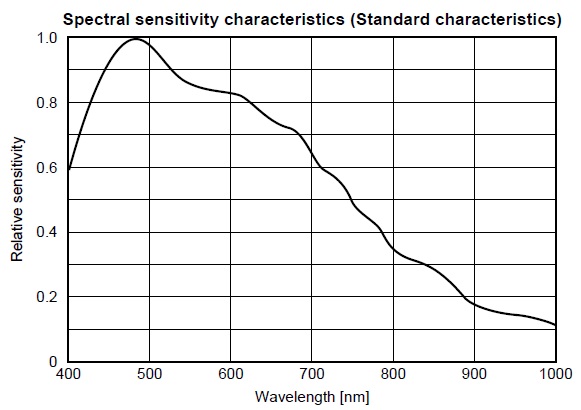
Design and construction of the RA-LSC-1707 line scan camera was completed in April 2016. The RA-LSC-1707 is a 7450-pixel monochrome line scan camera that runs at 1968 Hz. You can use this camera to scan objects, measure thickness, and measure the width of objects on a conveyor belt. This section shows the spectral response and parametric specifications.
Selection guide
Precise width and thickness gauging and fine-detail monochrome scanning
We built the RA-LSC-1707 for jobs where fine detail matters. This monochrome line-scan camera has 7,450 pixels of 4.7 μm over 35.015 mm and reads up to 1,968 lines/s. Its main work is width gauging, thickness gauging and surface inspection on medium-speed lines. The dynamic range is 1800:1, read by a 16-bit ADC.
- Sensor
- Linear CCD Array
- Effective pixels
- 2 × 3725=7450
- Pixel size
- 4.7 μm × 4.7 μm
- Active length
- 35.015 mm
- Line rate
- 1968 Hz
- Spectral range
- 400 nm to 1000 nm
- Dynamic range
- 1800
- ADC resolution
- 16 bit
- Minimum exposure
- 508 μs
- Maximum exposure
- 35 min
In a 350 mm field of view each pixel sees 47 μm of the object, and software processing finds the edge more precisely than one pixel. In width gauging every line is a separate measurement, so conveyor speed does not affect accuracy. 1,968 measurements per second is plenty for continuous control.
Light the part from behind and view it side-on. The thickness then appears as a shadow length on the sensor, and at 1:1 magnification each pixel sees 4.7 μm across a 35 mm field. The 16-bit ADC records the light-to-dark edge transition with plenty of gray levels.
To build a 2D image, object speed has to match the line rate. In a 350 mm field, where each pixel sees 47 μm, the object should move no faster than about 92 mm/s or the image will be stretched or squashed. The 1800:1 dynamic range helps faint scratches and stains stand out from the background.
On a 350 mm wide document each pixel sees 47 μm, about 540 dots per inch. The 16-bit ADC keeps subtle tonal differences intact.
The sensor responds up to 1000 nm, so near-infrared lighting is an option. For static, dim scenes the exposure goes up to 35 minutes. Gain adjusts up to 6 V/V in 64 steps.
The 4.7 μm × 4.7 μm pixel is small, only about 22 μm². Less light lands on each line, which is why the shortest exposure is 508 μs and the top line rate is 1,968 lines/s. In return, 7,450 pixels over 35.015 mm see a lot of detail. In a 350 mm field each pixel covers 47 μm of the object, and in a 700 mm field about 94 μm. To build a 2D image, the object must move exactly one pixel's worth per line period. For those two fields that means no faster than about 92 mm/s and 185 mm/s. Width gauging has no such limit, because each line is an independent measurement. The 1800:1 dynamic range is about 11 bits, and the 16-bit ADC covers it fully. The array is made of two 3,725-pixel halves, and gain and offset adjustment bring the two halves to the same level. The sensor responds from 400 to 1000 nm and works with white or near-infrared light.
The focal length is roughly working distance × 35.015 mm ÷ field-of-view width. With 4.7 μm pixels, choose a lens that renders detail finer than that sharply along the whole line. White or near-infrared light works well. At full speed the exposure stays at about 508 μs, and your light must be bright enough within that time. For static scenes the exposure goes up to 35 minutes in 2 μs steps. The -I version includes an FPGA, gain and offset adjustment, a 16-bit ADC, 480 Mbit/s USB, analog output and on-board RAM, and needs no external power. If you need the same detail in color, look at the RA-LSC-2717 with 3 × 7,500 pixels of 4.7 μm.
| RA-LSC-1707 USB Line Scan Camera Parameters | Specification |
|---|---|
| Sensor | Linear CCD Array |
| Pixel Size | 4.7 μm x 4.7 μm |
| Pixel Distance | 4.7 μm |
| Line Width | 4.7 μm |
| Effective Pixels | 2X3725=7450 |
| Active Length | 35.015 mm |
| Spectral Range | 400 nm to 1000 nm |
| Max Pixel Frequency | 7.5 MHz |
| Dynamic Range | 1800 |
| PGA Gain Resolution | 6 V/V - 64Steps |
| Programmable Offset Resolution | 300 mV - 512Steps± |
| Power consumption | 1.5 W |
| External Power | Not Required |
| Operational Temperature Range | −10 to +55 °C |
| Operation Systems | Windows 64-bit And Linux |
| Communication Port | USB2.0 Port |
| Multiple Cameras | Supported |
| Device Driver | Yes |
| Sample Codes | Matlab,LabView,C++,C#,VB.Net,Python |
| Camera Selection Guide | RA-LSC-1707-I |
|---|---|
| Processor | FPGA |
| Gain Adjust | ✓ |
| Offset Adjust | ✓ |
| ADC Resolution | 16 bit |
| USB Speed | 480Mbit/S |
| Analog OutPut | ✓ |
| On Board RAM | ✓ |
| Jitter Order | < 6.3 ns |
| Exposure Min | 508 μs |
| Exposure Max | 35 min |
| Exposure Resolution | 2 μs |
| Line Rate | 1968 Hz |
| Operational Temperature Range | −10 to +55 °C |
| Availability | 3Days After Order |