


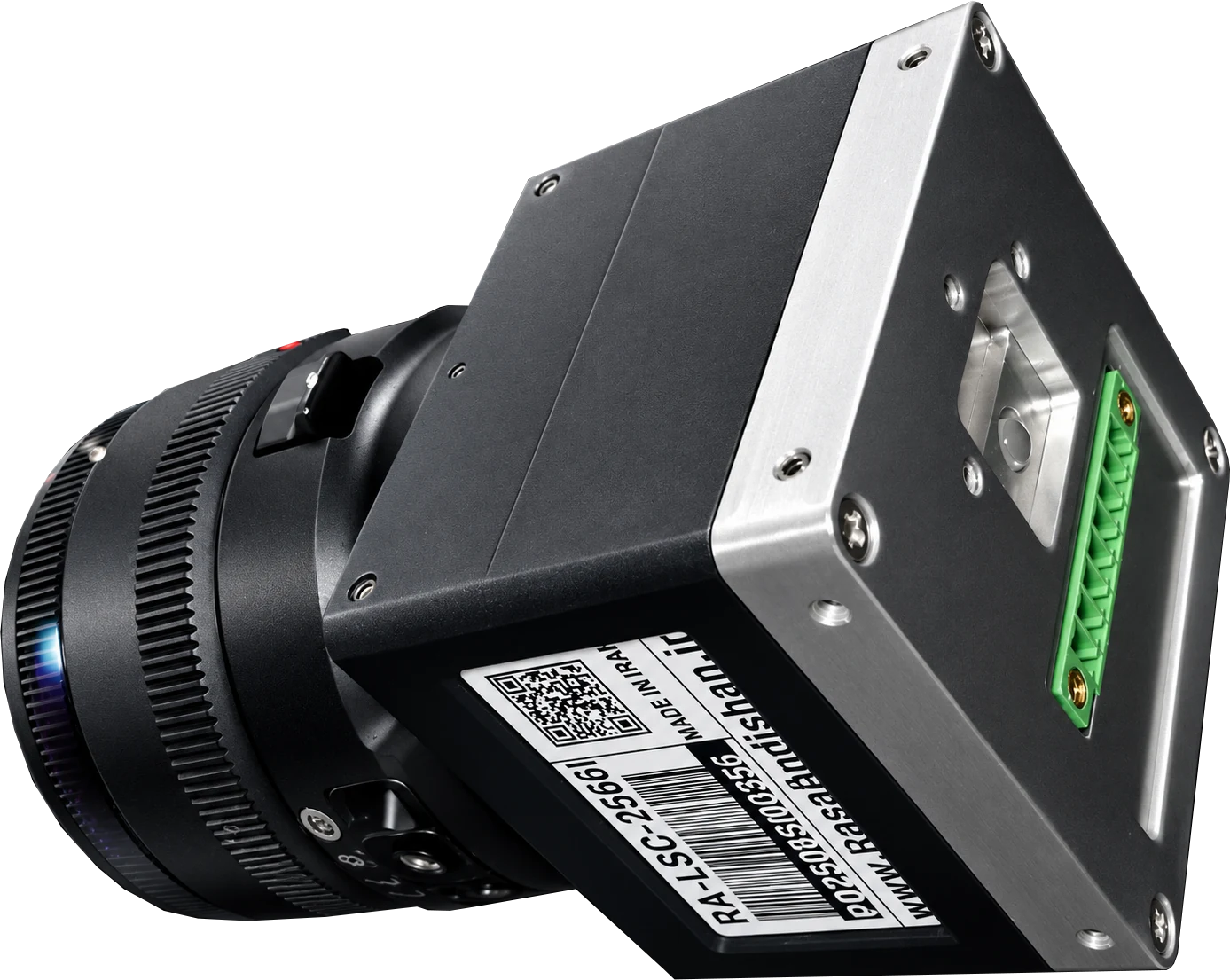
2048-pixel line scan camera, model RA-LSC-1209
Design and construction of the RA-LSC-1209 line scan camera was completed in August 2015. The RA-LSC-1209 is a 2048-pixel monochrome camera with a line rate of 7945 Hz. You can use it to scan objects, measure thickness, and measure the width of objects on a conveyor belt. This section shows the camera's spectral response and parametric specifications.
Selection guide
Surface inspection and width gauging on fast production lines
We built the RA-LSC-1209 for lines where sheet or web material passes under the camera at high speed, and it runs at 7,945 lines/s. The sensor has 2,048 square pixels of 14 μm × 14 μm on a 28.672 mm active length and reads each line in about 126 μs. The 2000:1 dynamic range is captured by a 16-bit ADC. Spectral response is 400 to 1100 nm, and the camera operates from -25 to +65 °C.
- Sensor
- Linear CCD Array
- Effective pixels
- 1 × 2048
- Pixel size
- 14 μm × 14 μm
- Active length
- 28.672 mm
- Line rate
- 7945
- Spectral range
- 400 nm to 1100 nm
- Dynamic range
- 2000
- ADC resolution
- 16 bit
- Minimum exposure
- 125.8 μs
- Maximum exposure
- 8.5 min
In a 287 mm field of view each pixel sees 0.14 mm of the surface. To keep the image from being stretched or squashed, the sheet should move no faster than about 1.1 m/s. The 2000:1 dynamic range helps reveal defects that are only slightly darker or brighter than the background.
In width gauging every line is an independent measurement, so object speed is not a limit. With 7,945 measurements per second, edge oscillations with periods of a few milliseconds become visible. The 16-bit ADC records the edge with enough gray levels for software to place it to better than one pixel.
The camera views the product from the side with light behind it, so thickness is simply the shadow length across the 2,048 pixels. At 1:1 magnification (a 28.672 mm field) each pixel sees 14 μm of the object. In a 143 mm field that becomes 70 μm.
The sensor responds up to 1100 nm. For materials that show better contrast in the near-IR, you can use near-IR LED lighting. The lower sensitivity in that region is compensated by gain adjustment up to 6 V/V in 64 steps.
The edge position is read every 126 μs, which leaves good margin for control loops with a bandwidth of a few hundred hertz. Timing jitter below 6.3 ns keeps each line steadily synchronized with the encoder.
At 7,945 lines/s each line lasts 126 μs, and the minimum exposure is 125.8 μs. So at full speed the exposure takes up almost the whole line, and the 14 μm × 14 μm pixel must gather enough light in that short window. In practice, your lighting decides which line rate you can use. The speed rule is simple: the object should move exactly one pixel's worth per line. If each pixel sees 0.14 mm of the object, the maximum speed is about 1.1 m/s. In a 410 mm field, where each pixel sees 0.2 mm, it rises to about 1.6 m/s. The 2000:1 dynamic range is captured by the 16-bit ADC without loss, and the 400 to 1100 nm response leaves you free to choose white or near-IR lighting.
The lens focal length is roughly working distance × 28.672 mm ÷ field-of-view width. Set the line rate against the line speed so the object advances exactly one pixel per line; encoder synchronization helps a lot here. Take lighting seriously. Because the 125.8 μs minimum exposure is about one full line period at 7,945 lines/s, the light must deliver enough signal within that time. For darker scenes, lower the line rate (the maximum exposure is 8.5 minutes). The -I version has an FPGA, gain and offset adjustment, a 16-bit ADC, 480 Mbit/s USB, an analog output and on-board RAM. If you do not need this speed and a tall pixel would serve you better, look at the RA-LSC-1205, with the same 2,048 pixels on 28.672 mm.

| RA-LSC-1209 USB Line Scan Camera Parameters | Specification |
|---|---|
| Sensor | Linear CCD Array |
| Pixel Size | 14 μm x 14 μm |
| Pixel Distance | 14 μm |
| Line Width | 14 μm |
| Effective Pixels | 1X2048 |
| Active Length | 28.672 mm |
| Spectral Range | 400 nm to 1100 nm |
| Max Pixel Frequency | 16.66 MHz |
| Dynamic Range | 2000 |
| PGA Gain Resolution | 6 V/V - 64Steps |
| Programmable Offset Resolution | 300 mV - 512Steps± |
| Power consumption | 1.5 W |
| External Power | Not Required |
| Operational Temperature Range | −25 to +65 °C |
| Operation Systems | Windows 64-bit And Linux |
| Communication Port | USB2.0 Port |
| Multiple Cameras | Supported |
| Device Driver | Yes |
| Sample Codes | Matlab,LabView,C++,C#,VB.Net,Python |
| Camera Selection Guide | RA-LSC-1209-I |
|---|---|
| Processor | FPGA |
| Gain Adjust | ✓ |
| Offset Adjust | ✓ |
| ADC Resolution | 16 bit |
| USB Speed | 480Mbit/S |
| Analog OutPut | ✓ |
| On Board RAM | ✓ |
| Jitter Order | < 6.3 ns |
| Exposure Min | 125.8 μs |
| Exposure Max | 8.5 min |
| Exposure Resolution | 1 μs |
| Line Rate | 7945 |
| Operational Temperature Range | −25 to +65 °C |
| Availability | 3Days After Order |