


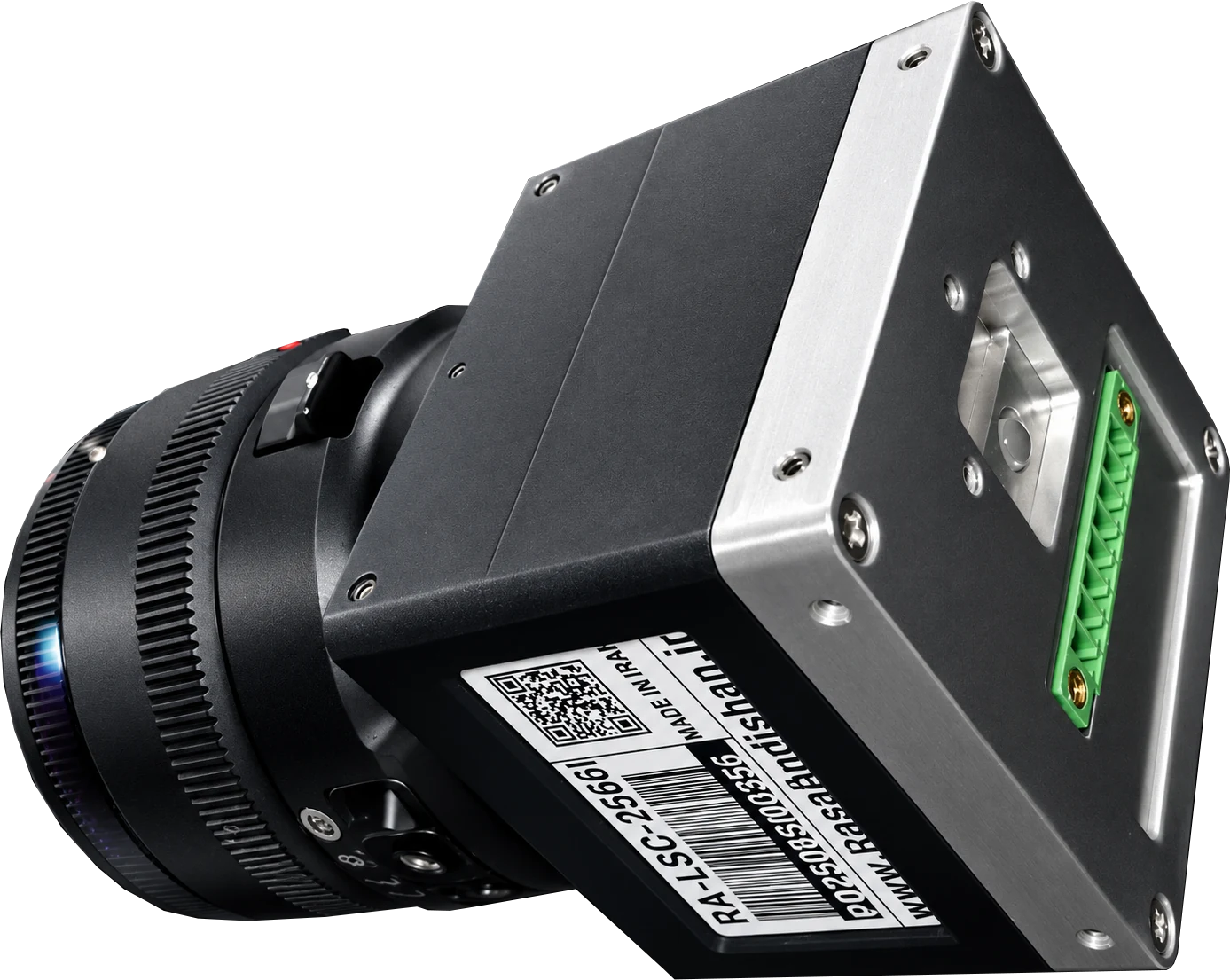
10680-pixel line scan camera, model RA-LSC-2950
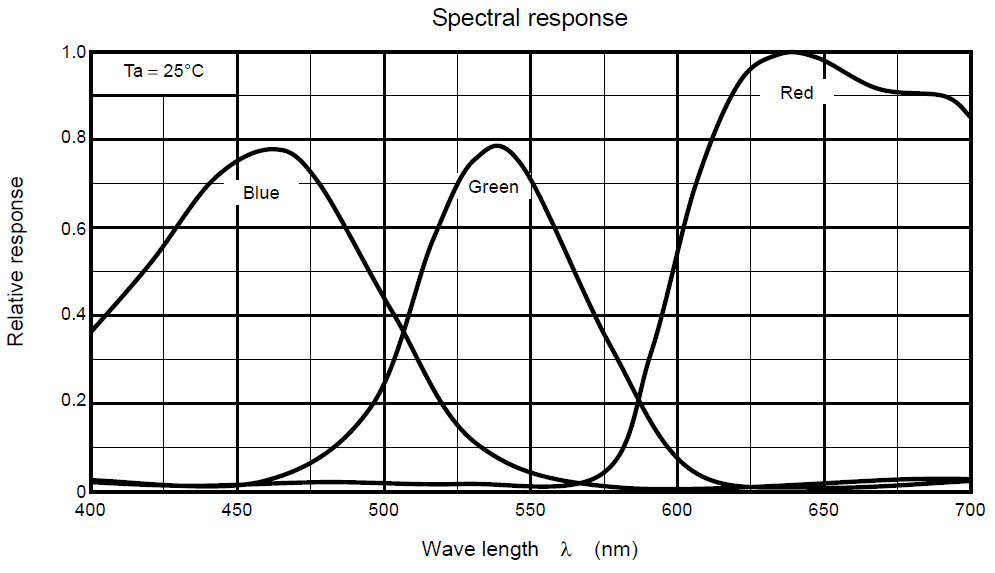
Design and construction of the RA-LSC-2950 line scan camera was completed in March 2018. The RA-LSC-2950 is a 10680-pixel color line scan camera that operates at 760 Hz. You can use this camera to measure object width and to scan objects on a conveyor belt. The spectral response and parametric specifications of this line scan camera are shown below.
Selection guide
Fine-detail color scanning of documents, drawings and flat surfaces
Scanning documents, drawings and flat surfaces in very fine detail is what we built the RA-LSC-2950 for. Its 6 × 10,680 linear CCD gives 10,680 pixels per color channel on a 4 μm pitch over 42.720 mm, with a 7000:1 dynamic range. The line rate goes up to 760 lines/s, and exposure is adjustable from 1,315 μs to 14 minutes in 1 μs steps. That puts this camera in scanners and static or slow-moving stations, not fast production lines.
- Sensor
- Linear CCD Array
- Effective pixels
- 6 × 10680
- Pixel size
- 2.8 μm × 4 μm
- Active length
- 42.720 mm
- Line rate
- 760 Hz
- Spectral range
- 400 nm to 700 nm
- Dynamic range
- 7000
- ADC resolution
- 3 × 8 bit
- Minimum exposure
- 1315 μs
- Maximum exposure
- 14 min
With a 267 mm field of view, each pixel sees 25 μm of the document, about 1,016 dpi. To keep the image from stretching or squashing, the document should move no faster than about 19 mm/s.
The sensor has a 7000:1 dynamic range, but the 8-bit ADC records only 256 levels. So you use gain (64 steps) and offset (512 steps) to fit the artwork's brightness range into the converter. The artwork doesn't move, so you can raise exposure up to 14 minutes and work with low light.
Each 10,680-pixel line is a separate width measurement, giving you 760 readings per second. With a 534 mm field of view each pixel sees 50 μm of the object. Belt speed doesn't matter here, because you are not building a two-dimensional image from the lines.
Sheet, fabric or circuit boards moving at a few tens of millimetres per second give an undistorted color image, as long as each pixel sees about 30 to 50 μm of the surface. The three 8-bit channels record color differences separately from brightness differences.
The strength of this model is its 4 μm pixel pitch: 10,680 pixels per color channel over 42.720 mm give you a lot of detail across the line. The price is a small pixel. Each line needs at least 1,315 μs of exposure, which is why the line rate is 760 lines/s. In practice, if each pixel sees 25 μm of the object, the object should move no faster than about 19 mm/s to avoid a stretched or squashed image. The 7000:1 dynamic range is wider than the 256 levels of the 8-bit ADC, so you pick your brightness range with gain and offset. The data rate is about 195 Mbit/s, which fits in the 480 Mbit/s USB link. No external power supply is needed.
The lens focal length is roughly working distance × 42.720 mm ÷ field-of-view width. For a 267 mm field at 500 mm, for example, you need a lens of about 80 mm. The lens should resolve close to 4 μm along the whole line. Choose lighting that gives enough signal within 1,315 μs. If it doesn't, lower the line rate, or for static scans raise exposure up to 14 minutes. The -I version includes an FPGA, gain and offset adjustment, a 3 × 8-bit ADC, 480 Mbit/s USB and on-board RAM, and ships 3 days after order. If you don't need color, the RA-LSC-2950-BW has the same sensor geometry.
Selection guide
Monochrome scanning of film and text at 4 μm pitch, and precise edge gauging
When you don't need color but fine detail matters, the monochrome RA-LSC-2950 is the one to use. It uses the same linear CCD as the color version (2.8 μm × 4 μm pixels) over the same 42.720 mm active length. Here two interlaced sensor lines are read side by side, so each image line has 21,360 pixels over that same length. Dynamic range is 7000:1, the ADC is 3 × 8 bits, and the camera captures up to 760 lines/s with exposure from 1,315 μs to 14 minutes. Its main jobs are static film and text scanning, and width and edge gauging at resolutions finer than 50 μm.
- Sensor
- Linear CCD Array
- Effective pixels
- 6 × 10680
- Pixel size
- 2.8 μm × 4 μm
- Active length
- 42.720 mm
- Line rate
- 760 Hz
- Spectral range
- 400 nm to 700 nm
- Dynamic range
- 7000
- ADC resolution
- 3 × 8 bit
- Minimum exposure
- 1315 μs
- Maximum exposure
- 14 min
A 36 mm frame fills the 42.720 mm active length at 1.19× magnification, so each pixel sees 3.4 μm of film. For dense negatives that pass little light, you can raise exposure up to 14 minutes in static capture.
With a 160 mm field of view, each pixel sees 15 μm of the page, about 1,690 dpi. The camera captures 760 lines/s, so to keep the text from stretching or squashing, the document should move no faster than 11.4 mm/s.
All 10,680 pixels in a line respond to the same band, so the edge is recorded without any shift between color channels. With a 214 mm field of view each pixel sees 20 μm of the object, and you get 760 independent measurements per second.
With the 4 μm pixel pitch and a field where each pixel sees 10 to 20 μm of the surface, scratches and cracks a few tens of micrometres wide show up on glass and sheet. Since each line takes at least 1,315 μs, the surface has to move slowly, roughly 8 to 15 mm/s.
In the monochrome version each 2.8 μm × 4 μm pixel receives the full 400 to 700 nm band, while in the color version each channel sees only part of it. The result is higher sensitivity. Even so, the pixel area is about 11.2 μm², which is still small. The 1,315 μs minimum exposure equals the line period at 760 lines/s, so you still need good lighting. How much of the object each pixel sees depends on the 4 μm pitch and the lens magnification: 15 μm per pixel in a 160 mm field and about 40 μm in a 427 mm field. In those two cases the object should move no faster than 11.4 mm/s and 30 mm/s respectively. The 7000:1 dynamic range is wider than the 256 levels of the 8-bit ADC, so you fit your brightness range into the converter with the 64-step gain and 512-step offset.
The lens focal length is roughly working distance × 42.720 mm ÷ field-of-view width. Film scanning needs a magnification close to 1, and the lens should resolve about 4 μm across the full 42.720 mm. Lighting must give enough signal within 1,315 μs. For dense film, lower the line rate and raise exposure in 1 μs steps up to 14 minutes. The -I version includes an FPGA, gain and offset adjustment, a 3 × 8-bit ADC, 480 Mbit/s USB and on-board RAM, and operates from 0 to +60 °C. If you need color, choose the RA-LSC-2950 with the same geometry.
| RA-LSC-2950 USB Line Scan Camera Parameters | Specification |
|---|---|
| Sensor | Linear CCD Array |
| Pixel Size | 2.8 μm x 4 μm |
| Pixel Distance | 4 μm |
| Line Width | 2.8 μm |
| Effective Pixels | 6X10680 |
| Active Length | 42.720 mm |
| Spectral Range | 400 nm to 700 nm |
| Dynamic Range | 7000 |
| PGA Gain Resolution | 6 V/V - 64Steps |
| Programmable Offset Resolution | 300 mV - 512Steps± |
| Power consumption | 1.5 W |
| External Power | Not Required |
| Operational Temperature Range | 0 to +60 °C |
| Operation Systems | Windows 64-bit And Linux |
| Communication Port | USB2.0 Port |
| Multiple Cameras | Supported |
| Device Driver | Yes |
| Sample Codes | Matlab,LabView,C++,C#,VB.Net,Python |
| Camera Selection Guide | RA-LSC-2950-I |
|---|---|
| Processor | FPGA |
| Gain Adjust | ✓ |
| Offset Adjust | ✓ |
| ADC Resolution | 3x8 bit |
| USB Speed | 480Mbit/S |
| On Board RAM | ✓ |
| Jitter Order | < 6.3 ns |
| Exposure Min | 1315 μs |
| Exposure Max | 14 min |
| Exposure Resolution | 1 μs |
| Line Rate | 760 Hz |
| Operational Temperature Range | 0 to +60 °C |
| Availability | 3Days After Order |