


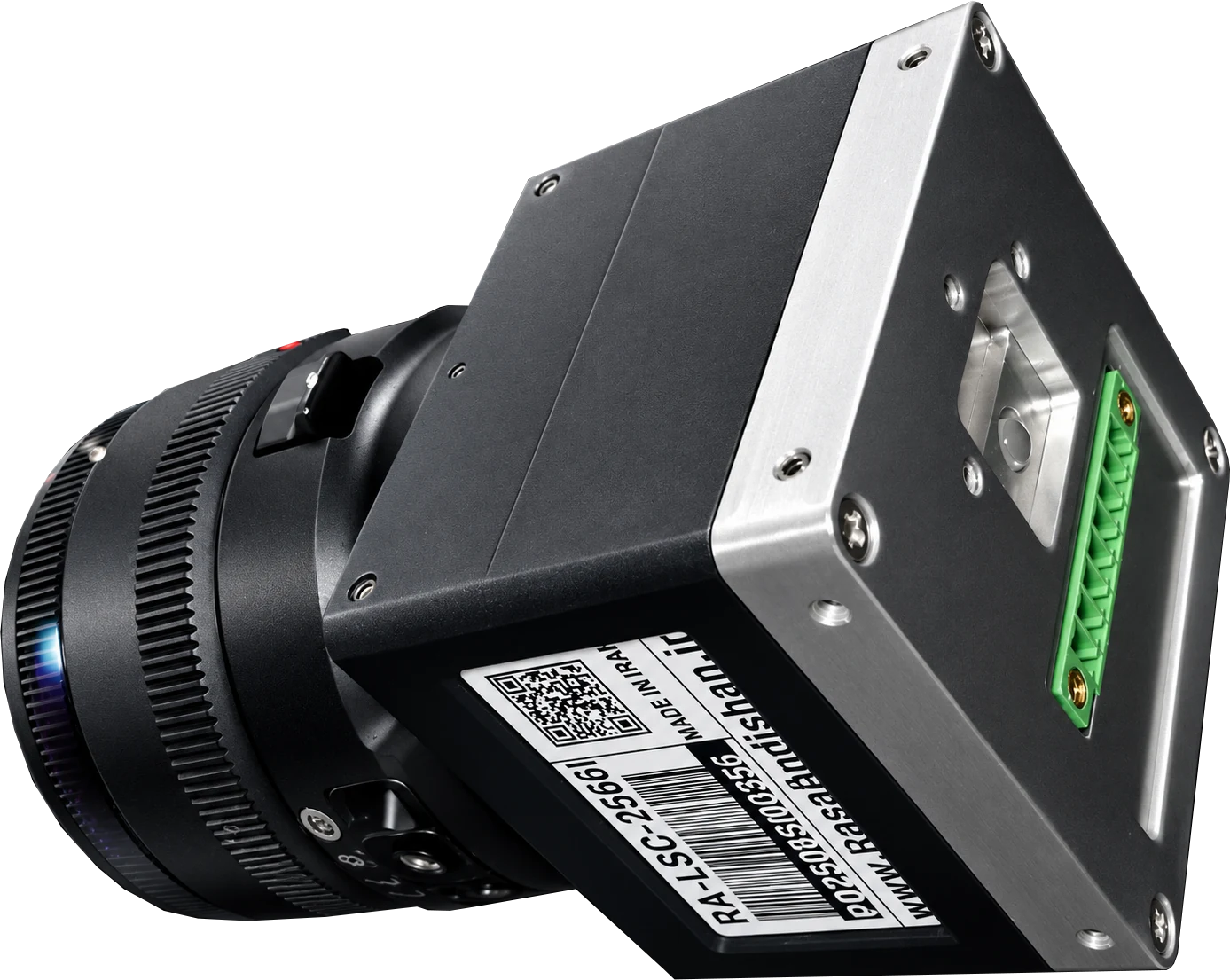
256-pixel line scan camera, model RA-LSC-1402
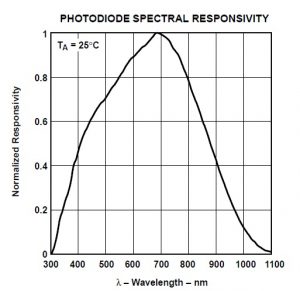
Design and construction of the RA-LSC-1402 line scan camera was completed in January 2016. The RA-LSC-1402 is a 256-pixel monochrome camera with a line rate of 27625 Hz. You can use it for high-speed scanning of objects. This section shows the spectral response and parametric specifications.
Selection guide
Edge, position and presence sensing on very fast lines
Speed is what this camera is about. The RA-LSC-1402 reads 27,625 lines per second, one full line every 36.2 μs. The trade-off is a small pixel count: 256 large pixels over 16.248 mm. It is a good fit for position and edge sensing, object counting and laser-spot tracking on high-speed lines.
- Sensor
- Linear CCD Array
- Effective pixels
- 1 × 256
- Pixel size
- 63.5 μm × 55.5 μm
- Active length
- 16.248 mm
- Line rate
- 27625 Hz
- Spectral range
- 300 nm to 1100 nm
- Dynamic range
- 4000
- ADC resolution
- 16 bit
- Minimum exposure
- 36.2 μs
- Maximum exposure
- 14.5 min
You get a full 256-pixel profile every 36.2 μs, and an object moving at 1 m/s advances only 36 μm between two lines. In a 64 mm field of view each pixel sees 0.25 mm of the object. Software processing then locates the edge more precisely than one pixel.
Each pixel has about 3,500 μm² of area, so even a 36.2 μs exposure collects enough light to find the spot centre. The 55.5 μm pixel height lets the beam wander up or down a little without leaving the sensor. With a 4000:1 dynamic range, the spot peak and the background are captured together in one readout.
Spread 300 to 1100 nm across 256 pixels and each pixel sees about 3.1 nm of the spectrum. That is enough for process monitoring, and in return you get up to 27,625 spectra per second. The 16-bit ADC catches small changes in intensity.
Each line is only 256 samples of 16 bits. Even at the maximum line rate the data comes to about 113 Mbit/s, which the 480 Mbit/s USB link carries easily. Object passage, spacing and length are resolved to 36.2 μs.
When the source is weak, raise the exposure anywhere from 36.2 μs to 14.5 minutes in 1 μs steps. Gain adjusts in 64 steps up to 6 V/V to place the signal well within the converter range.
The pixels are large: 63.5 μm × 55.5 μm, about 3,500 μm². That area is what lets a 36.2 μs exposure still collect enough signal, so the camera can run at 27,625 lines/s. The shortest exposure equals the line period, so at full speed signal quality depends only on how bright your light is. The flip side is the low pixel count. Each pixel sees the field-of-view width divided by 256, for example 0.25 mm in a 64 mm field. In edge and position measurement every line is a separate measurement, so object speed does not affect accuracy. The 4000:1 dynamic range is about 12 bits, and the 16-bit ADC covers it fully. That is why an edge or spot centre can be located more precisely than one pixel. The sensor responds from 300 to 1100 nm and operates from 0 to +70 °C.
The focal length is roughly working distance × 16.248 mm ÷ field-of-view width. Before you buy, do this check: the field width divided by 256 is what each pixel sees, and it has to match the accuracy you need. Your lighting must give enough signal within 36.2 μs. If the scene is dark, lower the line rate and lengthen the exposure (up to 14.5 minutes). The -I version includes an FPGA, gain and offset adjustment, a 16-bit ADC, 480 Mbit/s USB, analog output and on-board RAM, with jitter below 6.3 ns. If more pixels matter more to you than speed, look at the RA-LSC-1209: 2,048 pixels and 7,945 lines/s.
| RA-LSC-1402 USB Line Scan Camera Parameters | Specification |
|---|---|
| Sensor | Linear CCD Array |
| Pixel Size | 63.5 μm x 55.5 μm |
| Pixel Distance | 8 μm |
| Line Width | 63.5 μm |
| Effective Pixels | 1X256 |
| Active Length | 16.248 mm |
| Spectral Range | 300 nm to 1100 nm |
| Max Pixel Frequency | 7.5 MHz |
| Dynamic Range | 4000 |
| PGA Gain Resolution | 6 V/V - 64Steps |
| Programmable Offset Resolution | 300 mV - 512Steps± |
| Power consumption | 1.5 W |
| External Power | Not Required |
| Operational Temperature Range | 0 to +70 °C |
| Operation Systems | Windows 64-bit And Linux |
| Communication Port | USB2.0 Port |
| Multiple Cameras | Supported |
| Device Driver | Yes |
| Sample Codes | Matlab,LabView,C++,C#,VB.Net,Python |
| Camera Selection Guide | RA-LSC-1402-I |
|---|---|
| Processor | FPGA |
| Gain Adjust | ✓ |
| Offset Adjust | ✓ |
| ADC Resolution | 16 bit |
| USB Speed | 480Mbit/S |
| Analog OutPut | ✓ |
| On Board RAM | ✓ |
| Jitter Order | < 6.3 ns |
| Exposure Min | 36.2 μs |
| Exposure Max | 14.5 min |
| Exposure Resolution | 1 μs |
| Line Rate | 27625 Hz |
| Operational Temperature Range | 0 to +70 °C |
| Availability | 3Days After Order |