


2048-pixel line scan camera, model RA-LSC-1205
The RA-LSC-1205 line scan camera has been designed and built in four versions. The RA-LSC-1205 is a 2048-pixel line scan camera with a line rate of 951 Hz. You can use it to scan objects and to measure the width of objects on a conveyor belt. This section shows the camera's spectral response, parametric specifications, demo software features, and the specifications of each version.
Selection guide
Visible and near-IR spectrometers and low-light measurement
Tall 14 μm × 200 μm pixels are the defining feature of the RA-LSC-1205, and they are why it performs well in weak light. The sensor has 2,048 pixels on a 28.672 mm active length, responds from 350 to 1100 nm, and accepts exposures from 3 μs to 35.5 minutes. The line rate is 951.5 lines/s and the dynamic range 400:1. We offer four versions, with a 16-bit or 12-bit ADC and an FPGA or microcontroller.
- Sensor
- Linear CCD Array
- Effective pixels
- 1 × 2048
- Pixel size
- 14 μm × 200 μm
- Active length
- 28.672 mm
- Line rate
- 951.5 Hz
- Spectral range
- 350 nm to 1100 nm
- Dynamic range
- 400
- ADC resolution
- 16 bit
- Minimum exposure
- 3 μs
- Maximum exposure
- 35.5 min
Spread the 350 to 1100 nm band over 2,048 pixels and each pixel sees about 0.37 nm of the spectrum. The 200 μm pixel height captures the whole slit image and makes spectrometer alignment much easier.
The laser line stays on the 200 μm pixels even if it moves up or down by several tens of micrometers. By computing the intensity center over neighboring pixels, we find the line position more precisely than the 14 μm pitch. The camera gives a new reading every 1.05 ms.
With a backlight, the object's shadow falls on the 2,048 pixels and the edges are found from it. In a 205 mm field of view each pixel sees 0.1 mm of the object. The tall pixels mean a slightly tilted camera mount does not cause trouble.
Each pixel has an area of about 2,800 μm², and the FPGA versions allow exposures up to 35.5 minutes. In the -P and -I versions, the 16-bit ADC records very weak signals in fine steps.
The sensor is sensitive up to 1100 nm, so near-IR laser lines and sources are recorded on the same array that sees the visible band. Gain adjustment up to 6 V/V in 64 steps evens out the sensitivity difference between the two ends of the spectrum.
For static and slow experiments, the microcontroller-based -S version with a 12-bit ADC, 67.9 μs to 27 ms exposure and 66.5 lines/s is fully adequate. Windows and Linux drivers and sample code for Matlab, LabVIEW, C++, C#, VB.Net and Python make setup simple.
Each 14 μm × 200 μm pixel has an area of 2,800 μm². At the same exposure, a larger pixel collects more light and gives a cleaner signal in weak light. At 951.5 lines/s you get a line every 1.05 ms, enough for continuous spectroscopy and process monitoring. The 400:1 dynamic range is captured by a 16-bit ADC, so the converter is never the limiting factor. The 350 to 1100 nm response lets you work with halogen lamps or near-IR lasers without changing the sensor. Exposures from 3 μs to 35.5 minutes in 1 μs steps cover light levels that differ by a factor of about 7 × 10^8.
The lens focal length is roughly working distance × 28.672 mm ÷ field-of-view width. In a spectrometer, choose a grating that spreads the spectrum over the full 28.672 mm; for width gauging, use a backlight. A 3 μs minimum exposure against a 1.05 ms line period handles bright sources without saturation, and up to 35.5 minutes is available for weak signals. The -P version is the most complete: FPGA, 16-bit ADC, 480 Mbit/s USB, analog output, on-board RAM, a lens, a casing of your choice and customizable firmware, with 7-day delivery. The -I version has the same electronics but no lens, casing or firmware customization. The -A version has a 12-bit ADC and 12 Mbit/s USB, without analog output or RAM. The -S version uses a microcontroller, is limited to 66.5 lines/s and has timing jitter below 200 ns.

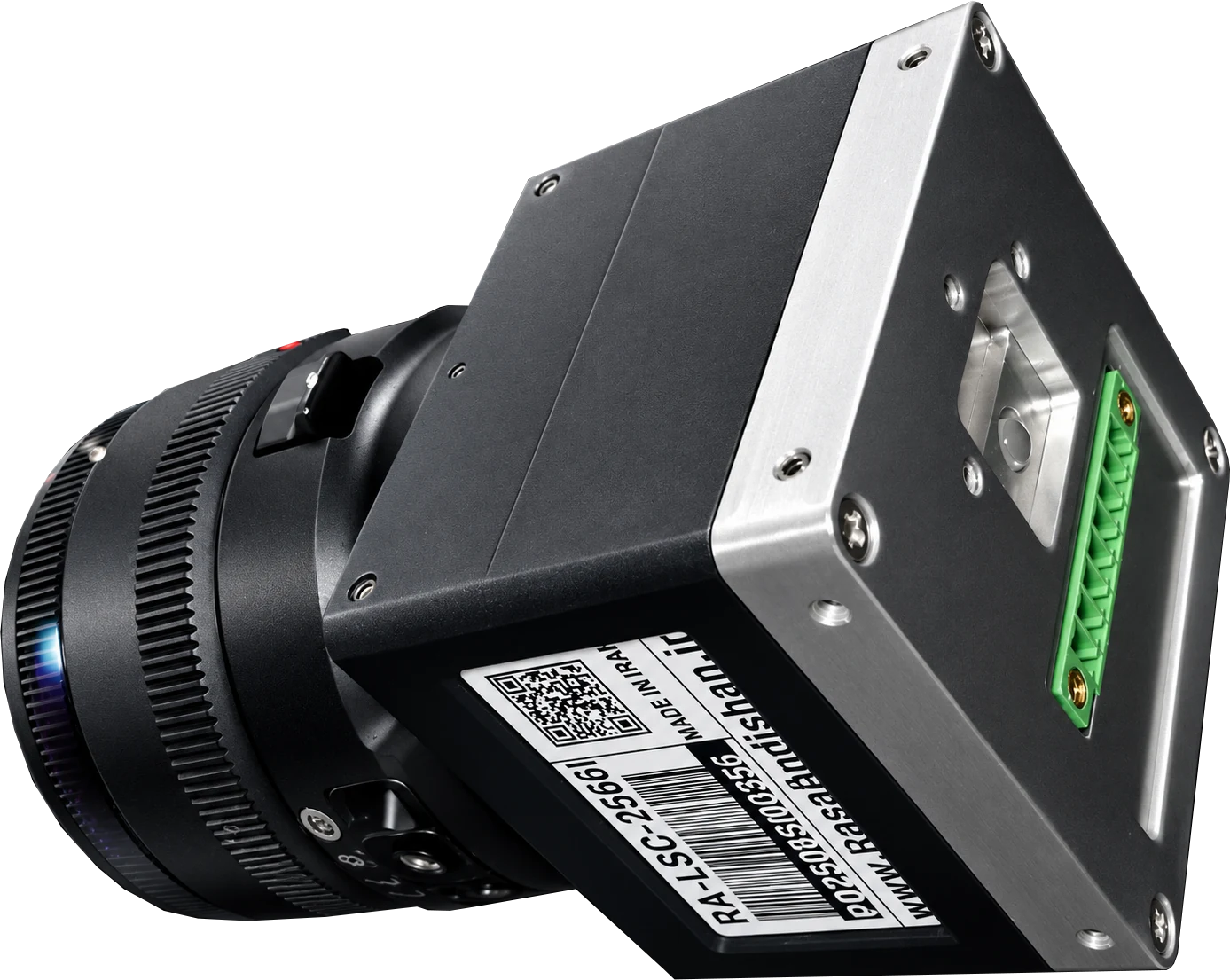
| RA-LSC-1205 USB Line Scan Camera Parameters | Specification |
|---|---|
| Sensor | Linear CCD Array |
| Pixel Size | 14 μm x 200 μm |
| Pixel Distance | 14 μm |
| Line Width | 200 μm |
| Effective Pixels | 1X2048 |
| Active Length | 28.672 mm |
| Spectral Range | 350 nm to 1100 nm |
| Max Pixel Frequency | 2 MHz |
| Dynamic Range | 400 |
| PGA Gain Resolution | 6 V/V - 64Steps |
| Programmable Offset Resolution | 300 mV - 512Steps± |
| Power consumption | 1.5 W |
| External Power | Not Required |
| Operational Temperature Range | −25 to +65 °C |
| Operation Systems | Windows 64-bit And Linux |
| Communication Port | USB2.0 Port |
| Multiple Cameras | Supported |
| Device Driver | Yes |
| Sample Codes | Matlab,LabView,C++,C#,VB.Net,Python |
| Camera Selection Guide | RA-LSC-1205-P | RA-LSC-1205-I | RA-LSC-1205-A | RA-LSC-1205-S |
|---|---|---|---|---|
| Processor | FPGA | FPGA | FPGA | Microcontroller |
| Gain Adjust | ✓ | ✓ | ✓ | ✓ |
| Offset Adjust | ✓ | ✓ | ✓ | ✓ |
| ADC Resolution | 16 bit | 16 bit | 12 bit | 12 bit |
| USB Speed | 480Mbit/S | 480Mbit/S | 12Mbit/S | 12Mbit/S |
| Analog OutPut | ✓ | ✓ | ✗ | ✗ |
| On Board RAM | ✓ | ✓ | ✗ | ✗ |
| Jitter Order | < 6.3 ns | < 6.3 ns | < 6.3 ns | < 200 ns |
| Exposure Min | 3 μs | 3 μs | 3 μs | 67.9 μs |
| Exposure Max | 35.5 min | 35.5 min | 35.5 min | 27 ms |
| Exposure Resolution | 1 μs | 1 μs | 1 μs | 12 μs |
| Line Rate | 951.5 Hz | 951.5 Hz | 951.5 Hz | 66.5HZ |
| Lens | ✓ | ✗ | ✗ | ✗ |
| Casing Model | Selectable By Customer | ✗ | ✗ | ✗ |
| Operational Temperature Range | −25 to +65 °C | −25 to +65 °C | −25 to +65 °C | −25 to +65 °C |
| Availability | 7Days After Order | 3Days After Order | 3Days After Order | 3Days After Order |
| Firmware Customizable | ✓ | ✗ | ✗ | ✗ |