


5340-pixel colour line scan camera RA-LSC-2566 – a camera for product sorting
The RA-LSC-2566-I line scan camera, featuring a CCD sensor,is an ideal choice for high-precision industrial applications. With a resolution of 5340 pixels and a sampling rate of 4536 Hz, the camera is designed to deliver fast, accurate and reliable performance in industrial conditions.
Selection guide
Color sorting and color inspection on fast production lines
Sorting produce and inspecting color on a production line takes both detail and speed. The RA-LSC-2566 has three 5,340-pixel lines for R, G and B and runs at up to 4,536 lines/s. Data goes over USB 3.0 at 600 Mbit/s, and the camera needs an external 6 to 8 V DC supply. The longest exposure is 20 ms, so this camera is built for bright, moving scenes.
- Sensor
- Linear CCD Array
- Effective pixels
- 3 × 5340
- Pixel size
- 5.25 μm × 6.825 μm
- Active length
- 28.035 mm
- Line rate
- 4536 Hz
- Spectral range
- 400 nm to 700 nm
- Dynamic range
- 2636
- ADC resolution
- RGB - 3 × 8 bit
- Minimum exposure
- 220 μs
- Maximum exposure
- 20 ms
In a 534 mm field of view each pixel sees 100 μm of the product. To keep the image from being stretched or squashed, the belt should run no faster than about 0.45 m/s. A 1 mm blemish then spans about 10 pixels, and the 2636:1 range picks up small color differences.
With 5,340 pixels per channel, fine detail holds up even across a wide field. In a field of about 1,070 mm each pixel sees 200 μm, and the line can run at up to about 0.9 m/s. Scratches and color deviations are found by comparing the R, G and B channels.
In a 280 mm field of view each pixel sees about 52 μm of the document, roughly 480 dots per inch in three 8-bit channels. With a 20 ms maximum exposure you need strong, continuous white light, and the document has to pass under the camera at a controlled speed.
In a 100 mm field of view each pixel sees about 19 μm, so even narrow barcode bars fall across several pixels. Each line takes 220 μs, and in this field the item should move no faster than about 0.085 m/s to avoid a stretched image.
The three channels are captured together, so misregistration and color shift on a moving web are easy to see. At the maximum line rate the data comes to about 581 Mbit/s, which fits within the 600 Mbit/s USB 3.0 link.
The pixels are 5.25 μm wide and 6.825 μm tall, about 36 μm² each. The extra height collects about 30 percent more light than a square 5.25 μm pixel, which helps the camera reach 4,536 lines/s with a 220 μs exposure. Each pixel sees the field-of-view width divided by 5,340. To avoid a stretched or squashed image, the object must move exactly one pixel's worth per line period. For example, when each pixel sees 100 μm, the speed should stay below about 0.45 m/s. The 2636:1 dynamic range is wider than the 256 levels of the 8-bit ADC. Gain and offset adjustment let you place the part of that range you care about inside the converter range. The sensor responds from 400 to 700 nm, the visible range. The longest exposure is 20 ms, so this camera is made for strong continuous light, not long exposures.
The focal length is roughly working distance × 28.035 mm ÷ field-of-view width. The 5.25 μm pixel calls for a high-quality lens with low chromatic aberration so the three RGB lines line up exactly. Lighting must be strong and continuous: at 4,536 lines/s the white light has only about 220 μs to give all three channels enough signal. The -I version includes an FPGA, gain and offset adjustment, a 3 × 8-bit color ADC and USB 3.0 at 600 Mbit/s. It needs a 6 to 8 V DC supply and operates from 0 to +60 °C. If you need long exposures or a larger pixel, the RA-LSC-2253 with 10.5 μm pixels and exposures up to 71 minutes is the better choice.
Sensor type: Linear CCD
Horizontal resolution: 5340 true colour (RGB) pixels
Sampling (line) rate: 4536 lines per second (Hz)
Exposure time adjustable with 1 µs precision
Compatible with Canon electronic lenses, with aperture and focus control in software
Adjustable image signal gain and offset
With its advanced optical and electronic features, this camera can be used in many applications, including:
✅ Agricultural product sorting
With accurate colour and texture recognition, the camera can grade fruit, vegetables, nuts and dried fruit by quality, size, colour or even blemishes. Its high colour separation accuracy makes it ideal for automated sorting lines.
✅ Defect detection on production lines
In the electronics, pharmaceutical or packaging industries, you can use this camera to inspect small defects such as scratches, leaks or color deviations.
✅ Scanning documents, maps and artwork
Some applications need accurate capture of texture and color, such as high-quality scanning of old documents, engineering drawings or paintings. It is suitable for scanning documents and drawings with controlled motion and strong lighting. If you are scanning artwork in low light, see the RA-LSC-2950.
✅ Reading colour codes and industrial barcodes
On advanced packaging lines, the camera can be used to read successive barcodes or colour codes at high speed.
✅ Machine vision systems
In machine vision systems, the camera can serve as a precise input for computer vision algorithms such as OCR, object detection and tracking.
High colour accuracy and image sharpness
High sampling rate for real-time processing
Designed for electrically noisy industrial environments
Customizable to project requirements
If you are looking for a professional solution for precise line scan imaging in industrial, agricultural or document scanning applications, the RA-LSC-2566-I is a suitable and cost-effective choice. Its combination of accuracy, speed and flexibility has made it a key tool in many machine vision and industrial automation projects.

Spectral response of the RA-LSC-2566
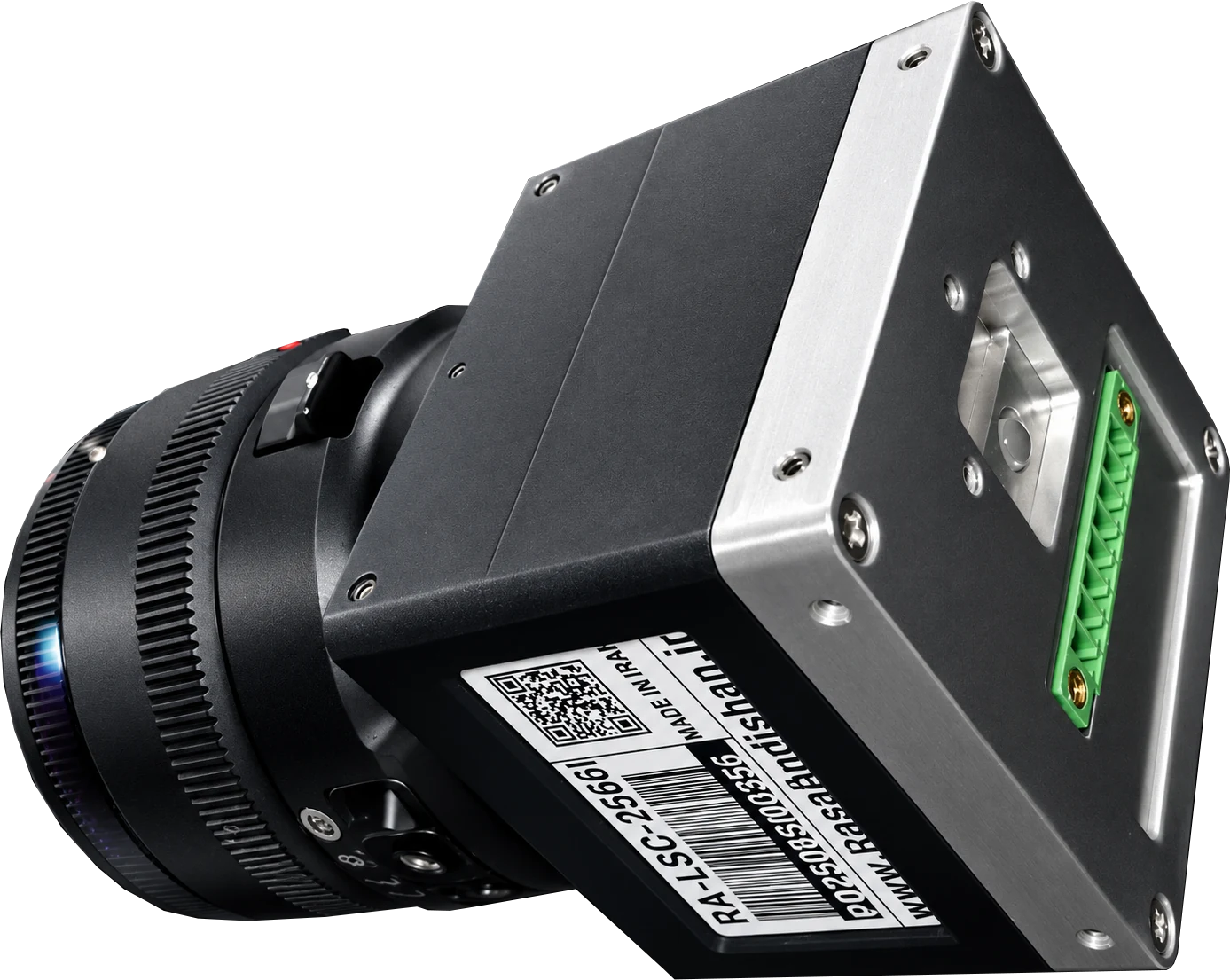
RA-LSC-2566-I line scan camera
| RA-LSC-2566 USB Line Scan Camera Parameters | Specification |
|---|---|
| Sensor | Linear CCD Array |
| Pixel Size | 5.25 μm x 6.825 μm |
| Pixel Distance | 5.25 μm |
| Line Width | 6.825 μm |
| Effective Pixels | 3X5340 |
| Active Length | 28.035 mm |
| Spectral Range | 400 nm to 700 nm |
| Dynamic Range | 2636 |
| PGA Gain Resolution | 6 V/V - 64Steps |
| Programmable Offset Resolution | 300 mV - 512Steps± |
| Power consumption | 1.5 W |
| External Power | DC6 V~DC8 V |
| Operational Temperature Range | 0 to +60 °C |
| Operation Systems | Windows 64-bit And Linux |
| Communication Port | USB3.0 Port |
| Multiple Cameras | Supported |
| Device Driver | Yes |
| Sample Codes | Matlab,LabView,C++,C#,VB.Net,Python |
| Camera Selection Guide | RA-LSC-2566-I |
|---|---|
| Processor | FPGA |
| Gain Adjust | ✓ |
| Offset Adjust | ✓ |
| ADC Resolution | RGB - 3X8 bit |
| USB Speed | 600Mbit/S |
| Exposure Min | 220 μs |
| Exposure Max | 20 ms |
| Exposure Resolution | 1 μs |
| Line Rate | 4536 Hz |
| Operational Temperature Range | 0 to +60 °C |
| Availability | 3Days After Order |