


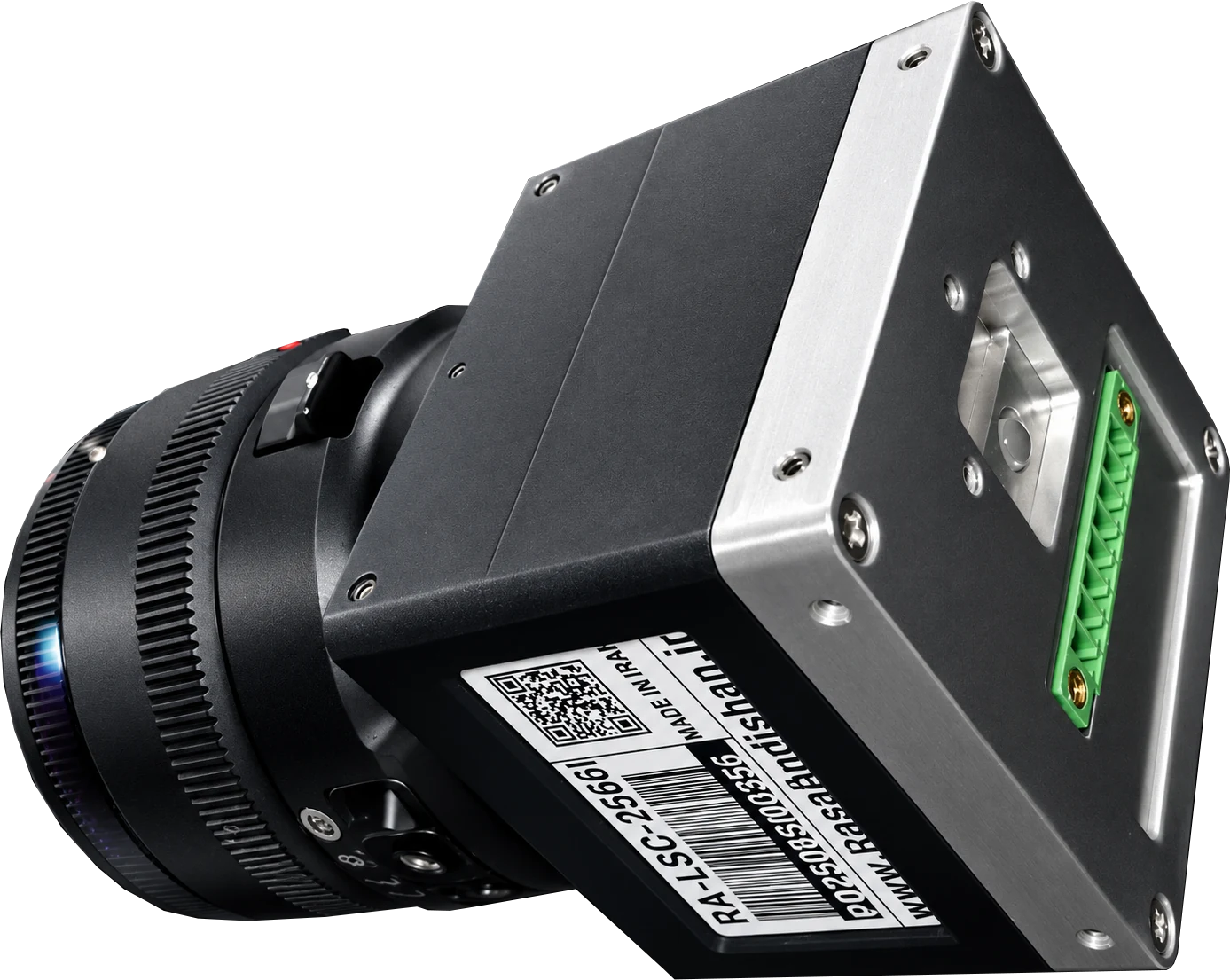
2500-pixel line scan camera, model RA-LSC-1254
The RA-LSC-1254 is a 2500-pixel monochrome camera that runs at 385 Hz. You can use it for thickness gauging and for measuring object width on a conveyor.
Selection guide
Detailed UV-VIS spectroscopy and laser thickness gauging
With 2,500 pixels on a 13.125 mm active length, the RA-LSC-1254 records spectra in very fine detail. Each pixel is 5.25 μm wide and 64 μm tall. We designed it for UV-VIS spectrometers and laser gauges that need to locate a position to better than one pixel. It offers 300 to 1000 nm spectral response, a 16-bit ADC, a 400:1 dynamic range and 385 lines/s.
- Sensor
- Linear CCD Array
- Effective pixels
- 1 × 2500
- Pixel size
- 5.25 μm × 64 μm
- Active length
- 13.125 mm
- Line rate
- 385 Hz
- Spectral range
- 300 nm to 1000 nm
- Dynamic range
- 400
- ADC resolution
- 16 bit
- Minimum exposure
- 10 μs
- Maximum exposure
- 14 min
In laser triangulation, the spot shift is recorded along the 13.125 mm array at a 5.25 μm pitch. By computing the intensity center over several pixels, we get the position more precisely than the pixel pitch. You get an independent thickness value every 2.6 ms.
With a backlight, the shadow edges of the object are found across 2,500 pixels, and in a 50 mm field of view each pixel sees 20 μm of the object. The 16-bit ADC records the edge slope with enough gray levels for software to place the edge between two pixels.
Spread the 300 to 1000 nm band over 2,500 pixels and each pixel sees about 0.28 nm of the spectrum. Sensitivity from 300 nm covers the near-UV for absorption work, and the 64 μm pixel height collects the slit light well.
The beam can drift vertically by up to 64 μm and still stay on the pixels. The 5.25 μm pitch is a good basis for finding the spot center, and exposures as short as 10 μs prevent saturation with powerful lasers.
For weak signals, extend the exposure up to 14 minutes. Each pixel has a 336 μm² area and collects about 12 times the light of a square 5.25 μm pixel. The 16-bit ADC records low signal levels in fine steps.
The pixel shape separates two needs. The 5.25 μm pitch sets how fine the spatial and spectral detail is. The 64 μm height (336 μm² area) collects about 12 times the light of a square pixel at the same pitch. At 385 lines/s you get a full line every 2.6 ms, enough for continuous thickness and width monitoring or for averaging several spectra. The 400:1 dynamic range is captured by a 16-bit ADC, so the converter step is far finer than the sensor noise. Offset adjustment up to ±300 mV in 512 steps keeps the dark level inside the converter range. The 300 to 1000 nm response covers deuterium and halogen lamps on one array, and exposures from 10 μs to 14 minutes handle light levels that differ by a factor of about 8 × 10^7.
The lens focal length is roughly working distance × 13.125 mm ÷ field-of-view width. The lens must resolve better than the 5.25 μm pitch along the whole line, or the fine pixels are wasted. In a spectrometer, choose a grating that spreads the spectrum over the full 13.125 mm. For width measurement, a backlight usually gives the best results. A 10 μs minimum exposure against a 2.6 ms line period keeps bright sources under control, and up to 14 minutes of exposure is available for weak signals. The -I version has an FPGA, gain and offset adjustment, a 16-bit ADC, 480 Mbit/s USB and on-board RAM, with timing jitter below 6.3 ns and no external power supply needed. If you need a longer array with more pixels, look at the RA-LSC-1304 (3,648 pixels of 8 μm × 200 μm on 29.184 mm).
Below you can see the spectral response and parametric specifications of the RA-LSC-1254.
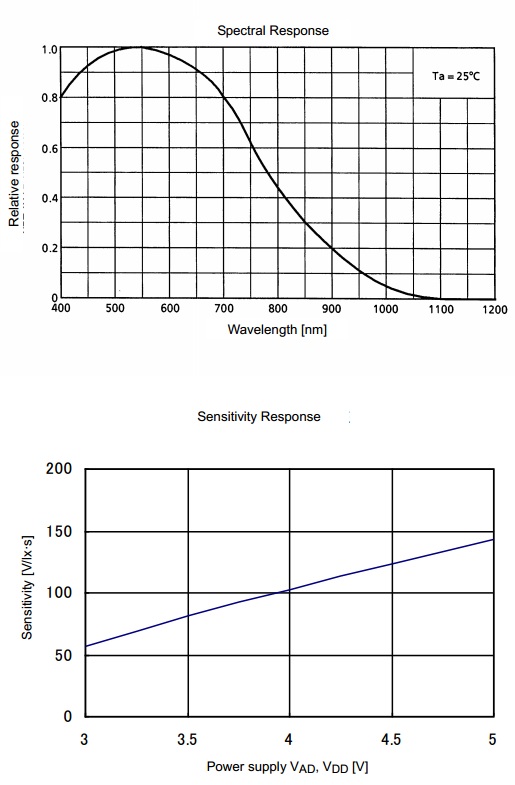
| RA-LSC-1254 USB Line Scan Camera Parameters | Specification |
|---|---|
| Sensor | Linear CCD Array |
| Pixel Size | 5.25 μm x 64 μm |
| Pixel Distance | 5.25 μm |
| Line Width | 64 μm |
| Effective Pixels | 1X2500 |
| Active Length | 13.125 mm |
| Spectral Range | 300 nm to 1000 nm |
| Max Pixel Frequency | 2 MHz |
| Dynamic Range | 400 |
| PGA Gain Resolution | 6 V/V - 64Steps |
| Programmable Offset Resolution | 300 mV - 512Steps± |
| Power consumption | 1.5 W |
| External Power | Not Required |
| Operational Temperature Range | −25 to +65 °C |
| Operation Systems | Windows 64-bit And Linux |
| Communication Port | USB2.0 Port |
| Multiple Cameras | Supported |
| Device Driver | Yes |
| Sample Codes | Matlab,LabView,C++,C#,VB.Net,Python |
| Camera Selection Guide | RA-LSC-1254-I |
|---|---|
| Processor | FPGA |
| Gain Adjust | ✓ |
| Offset Adjust | ✓ |
| ADC Resolution | 16 bit |
| USB Speed | 480Mbit/S |
| On Board RAM | ✓ |
| Jitter Order | < 6.3 ns |
| Exposure Min | 10 μs |
| Exposure Max | 14 min |
| Exposure Resolution | 1 μs |
| Line Rate | 385 Hz |
| Operational Temperature Range | −25 to +65 °C |
| Availability | 3Days After Order |
See every line scan camera model on the line scan camera page. To learn about this technology, read the Wikipedia article on line scan cameras.