


Article
Machine vision using image processing
Put very simply, machine vision based on image processing is a processor's ability to see its surroundings. It is worth noting that the term machine vision is mostly used for industrial applications of this capability. The human eye is sensitive to electromagnetic wavelengths in the 390-770 nanometer (nm) range. Imaging sensors, however, cover a wider spectral range than the human eye. For example, machine vision systems can be used in infrared (IR), ultraviolet (UV) or X-ray wavelengths, which the human eye certainly cannot detect. In a machine vision system, the image detector or camera sees the object or its surroundings. Processing hardware such as a computer, DSP or FPGA provides the processing platform. Specific software algorithms then process the image. The final output of a machine vision system can be, for example, precise guidance of a robot assembling a specific product. The camera, the optics and the lighting are the most important elements of any machine vision system. If you combine these elements intelligently, you can often greatly simplify the processor and the processing algorithms. For example, suppose you want to measure the length of a matchbox. If you project a line laser onto the matchbox, you see a red line with very high contrast. This line breaks at the edges of the matchbox. Suppose the laser angle is such that the line appears perfectly horizontal in the image. In this case you only need to threshold and binarize the image. Then you measure the length of the box with a simple algorithm in an FPGA. The main advantage of a machine vision system is that it does not get tired and its accuracy does not decrease over time. This raises product quality, lowers production costs and ultimately increases customer satisfaction.
Some applications of machine vision include:
- Electronic equipment analysis
- Signature recognition
- Character recognition
- Licence plate recognition
- Handwriting recognition
- Object recognition
- Pattern recognition
- Material quality inspection
- Banknote inspection
- Medical image analysis
- Face and smile detection
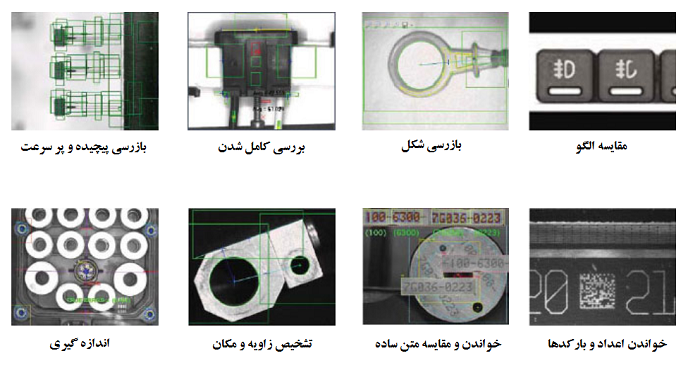
Some applications of machine vision
RasaAndishan Mowj Pardaz is proud to be one of the first manufacturers of various linear CCD detectors and area scan cameras, to supply everything you need for laboratory, commercial and industrial applications under the Made in Iran label.
Choosing the camera is the first step in designing any machine vision system. Area scan cameras build a complete image of the field of view in every frame. Line scan cameras capture only one line at a time. They are much better suited to image processing of moving objects.
RasaAndishan designs and builds both types of camera. The company's area scan cameras are used in license plate reading, particle image velocimetry and machine vision. All RasaAndishan cameras support external triggering. See the models on the Image processing camera page. The Wikipedia article on machine vision also gives you a full picture of this field.