Designer and manufacturer of advanced imaging equipment
Wednesday, 7 October 2026
فا

Product family

Line scan cameras made in Iran

Iranian-made line scan cameras have been designed and built in a range of models through the efforts of RasaAndishan's specialists.
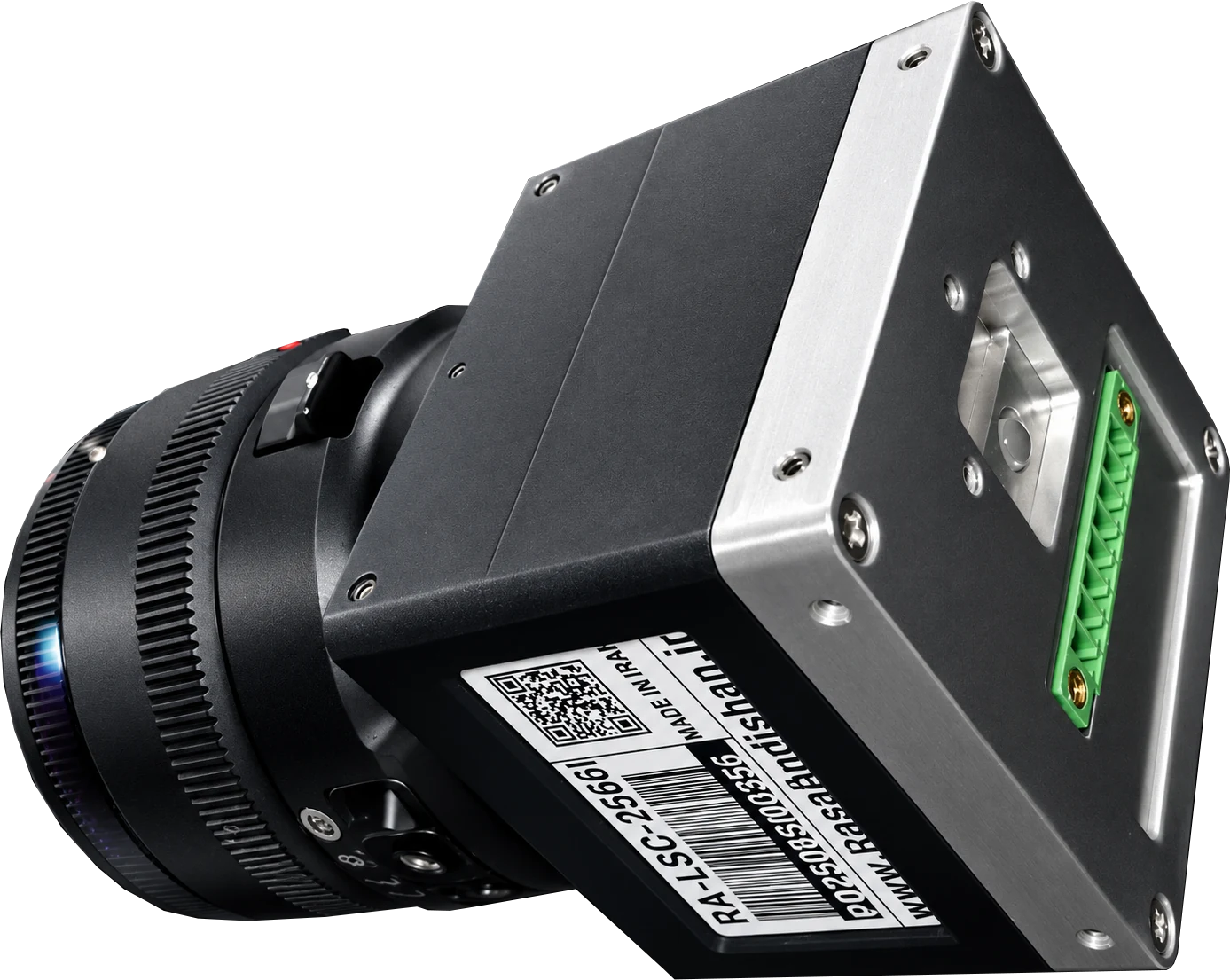
RA-LSC-2566I line scan camera made by RasaAndishan

What is a line scan camera, and how does it differ from an area scan camera?

A line scan camera, unlike an area scan camera, captures only a single line. It is much faster and far better suited to image processing of moving objects. The idea of line scan imaging may seem a little difficult at first, so we explain it with two examples.

Example one: inspecting a train body

Example 1: Suppose you want to inspect the body, paint, and so on of a train. One way is to step back from the train and take a single 2D image of the whole train with an area scan camera. Because you are far from the train, the image quality will not be very high. Another way is to take several 2D images of the train and stitch them together, but this takes a lot of time. With a line scan camera, you only need to position the camera so that the full width of the train fits in the camera's field of view. If the train then passes in front of the camera at a constant speed, the resulting 2D image has a very high resolution, and you can easily assess the train body visually. In the resulting image, the width equals the camera's resolution, for example 2048 pixels. The length of the image depends on how long you capture. So if you receive 10,000 lines from the camera, the image resolution will be 20 megapixels.

Example two: inspecting roads and railway tracks

Example 2: Suppose you want to inspect the condition of highways, roads, and railway tracks. The best way is to use a line scan camera mounted on a car or train. In the first example, the camera is fixed and the train moves. In the second example, the camera moves and the route is fixed. So with line scan cameras, the object and the camera must move relative to each other to form a 2D image. Applications of line scan cameras include solar sensors, barcode readers, scanners, spectroscopy, and systems that measure thickness, distance, speed, angle, color, vibration, and light intensity. Some line scan camera applications are shown in the figure below.

Line scan camera applications

  1. 1

    Edges from a laser shadow

    The object casts a shadow in the laser beam. The line scan camera reads the shadow edges and measures the width of the object or slit.
  2. 2

    Wire diameter by laser diffraction

    Laser light diffracts around a thin wire. The spacing of the fringes gives the wire diameter while the wire is being made.
  3. 3

    Glass thickness

    Light reflects from the top and bottom surfaces of the glass. The distance between the two bright spots on the sensor gives the thickness.
  4. 4

    Laser triangulation

    The camera views the laser spot from another angle. The shift of the spot on the sensor gives distance, surface profile or vibration.
  5. 5

    Imaging the earth from orbit

    The satellite moves and the line scan camera records one strip of ground at a time. The strips side by side make the full image.
  6. 6

    Measuring on a conveyor

    Parts pass under a laser line on the belt. The line scan camera measures the height and shape of each part as it goes by.
  7. 7

    Free-fall sorting

    Grains fall past the camera. Based on colour, size or defects, the machine sends each grain to its own chute.
  8. 8

    Sun sensor

    Sunlight passes through a slit onto part of the linear sensor. The position of the bright spot gives the sun angle.
  9. 9

    Spectroscopy

    A prism or grating spreads light into its wavelengths. Each pixel of the line scan camera reads the intensity of one wavelength.
  10. 10

    Continuous web inspection

    Sheet metal, paper or fabric runs under the camera without stopping. The line scan camera builds one seamless image of the whole surface.
  11. 11

    Train body inspection

    The train passes a fixed camera at constant speed. The resulting image has very high resolution and shows the body condition clearly.
  12. 12

    Scanning documents and artwork

    A scanner also reads one line of the page or painting at a time. Steady motion of the camera or the document builds a very detailed image of the whole surface.
Some applications of line scan cameras in science and industry

Line scan cameras made in Iran

Line scan cameras have a long history worldwide, but Iran still has few makers of them. RasaAndishan Mowj Pardaz is one of the first line scan camera makers in the country. We know what users of these cameras need, so you can get the right camera for your work easily and for less than a comparable imported one. The know-how is now local, and sensors from leading makers such as Sony, Toshiba, Sharp, Hamamatsu and NEC are used in these cameras.

Advice, warranty and support

Advice on choosing a camera is free. Every camera has a three-year unconditional warranty. We also help you get the camera running in your own software. All cameras in the table below connect over USB2 or USB3, and you can compare their parameters at a glance.

ALTRON software: process every line your way

All our line scan cameras work with the free ALTRON software. In ALTRON the data path is a graph, and each processing step is a node in it. You arrange the nodes in any order and save the graph for next time. To test without a camera, you can create a virtual camera with any resolution and speed. The main processing steps for line scan cameras:

  • Black level: Measures and sets the black level of each channel.
  • Dark and gain correction: Uses a dark and a white reference to even out pixel-to-pixel differences, so a uniform surface looks uniform.
  • Bad pixel correction: Finds bad pixels and rebuilds their values from their neighbours.
  • Colour line alignment: In a colour line scan camera, lines up the red, green and blue lines so no colour fringes appear at edges.
  • Colour correction: Builds a colour correction matrix or template from a colour chart and brings colours close to their true values.
  • Gamma: Balances the brightness of shadows and highlights for easier viewing.
  • Anti-flicker: Removes the light and dark bands that mains-powered lamps leave in a scanned image.
  • Averaging: Reduces noise by averaging consecutive lines, neighbouring pixels or the most recent lines.
  • Display rate limiting: Lowers the data rate for display and processing while the recorder still receives every line.
  • Scan direction gate: In back-and-forth scanning, keeps only the lines from one direction so the image does not get mixed up.

Viewing and saving data

To view the data you have a line plot viewer and a scanner viewer. The scanner viewer places lines side by side to build a continuous image of the strip or sheet. You can save the image in TIFF and JPEG and as raw data at the same time. Raw data can be played back later so you can try processing settings on the same data. The camera runs either free-running or triggered.

The new RasaAndishan camera software is plugin-based. You can define the data chain yourself, and take and save output from any part of it.
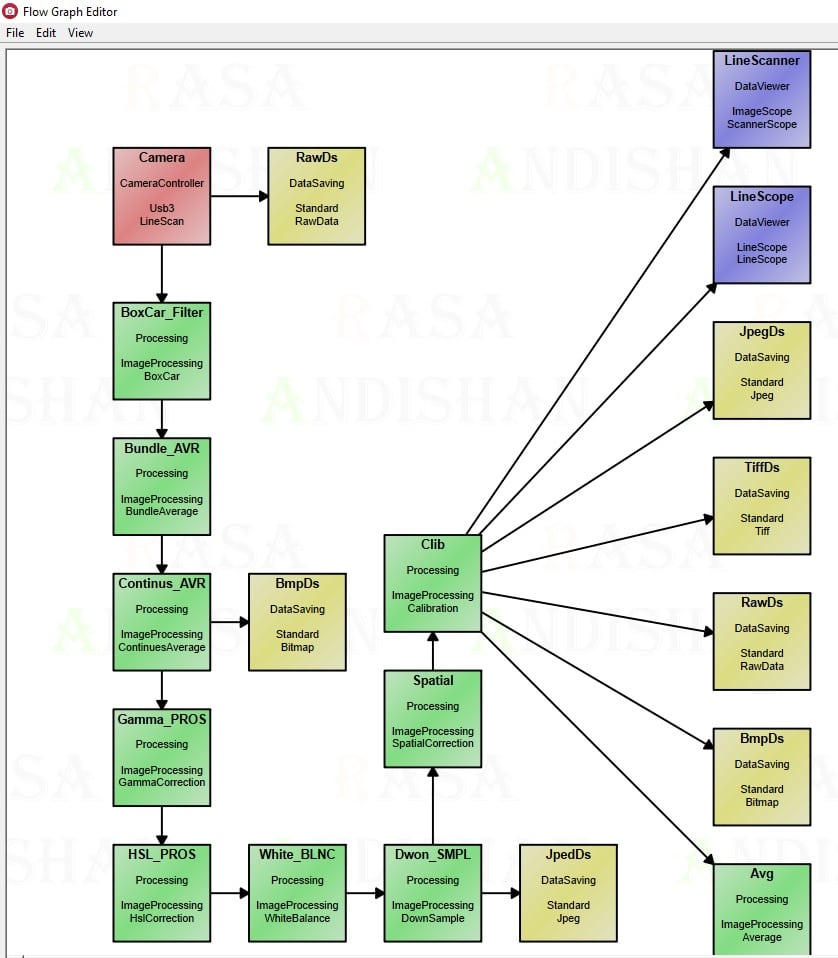
The Flow Graph Editor feature in RasaAndishan's line scan camera software

The flow graph feature in the line scan camera software

Line scan imaging in action

The section below demonstrates line scan imaging with RasaAndishan software.

Comparing line scan camera models

The comparison table below shows the different line scan cameras and their specifications.

Available models

Twenty line scan camera models

All values come from the RasaAndishan product datasheets. Line rate is in lines per second (Hz). Select a model name to open its full application guide.

Camera ModelColor / ResolutionLine RateElectronic ShutterPixel SizeDynamic RangeBest suited to
RA-LSC-05112048 / BW950 ✗14μm×200μm267Spectrometers and laser-line sensing under steady light, with 200 μm tall pixels
RA-LSC-05263000 / BW325 ✓7μm×200μm320Weak-signal spectroscopy in the visible and near-infrared, with long exposures
RA-LSC-05327500 / BW1050 ✗7μm×7μm8333Wide-format scanning and width gauging at better than 0.1 mm
RA-LSC-05512048 / BW1905 ✗14μm×14μm6000Width, thickness and edge gauging on production lines
RA-LSC-05535150 / BW951.5 ✗7μm×7μm6666Precise width gauging and scanning, including blue and near-UV light
RA-LSC-07185363 / RGB1020 ✗8μm×8μm10670Color scanning, print inspection and color sorting
RA-LSC-07512048 / BW2376 ✓14μm×14μm6000Scanning fast or vibrating objects, even under strong light
RA-LSC-11031500 / BW641 ✓5.5μm×64μm200Laser thickness gauging and compact spectrometers
RA-LSC-12052048 / BW950.5 ✓14μm×200μm400Visible and near-IR spectrometers and low-light measurement
RA-LSC-12092048 / BW7945 ✗14μm×14μm2000Surface inspection and width gauging on fast production lines
RA-LSC-12542500 / BW385 ✓5.25μm×64μm400Detailed UV-VIS spectroscopy and laser thickness gauging
RA-LSC-13043648 / BW270 ✓8μm×200μm300Raman and fluorescence spectroscopy and very weak light
RA-LSC-1402256 / BW27625 ✗63.5μm×55.5μm4000Edge, position and presence sensing on very fast lines
RA-LSC-17077450 / BW1968 ✗4.7μm×4.7μm1800Precise width and thickness gauging and fine-detail monochrome scanning
RA-LSC-22532700 / RGB2989 ✗10.5μm×10.5μm1750Color web and sheet inspection and color sorting at medium speed
RA-LSC-25665340 / RGB4536 ✗5.25μm×6.825μm2636Color sorting and color inspection on fast production lines
RA-LSC-27177500 / RGB1068 ✗4.7μm×4.7μm2000Detailed color scanning and width measurement
RA-LSC-295010680 / RGB760 ✗2.8μm×4μm7000Fine-detail color scanning of documents, drawings and flat surfaces
RA-LSC-2950-BW21360 / BW760 ✗2.8μm×4μm7000Monochrome scanning of film and text at 4 μm pitch, and precise edge gauging
RA-LSC-37532088 / BW940 ✗14μm×14μm375Precise gauging and spectroscopy from UV to near-infrared

RA-LSC-0511

Spectrometers and laser-line sensing under steady light, with 200 μm tall pixels

Color / Resolution
2048 / BW
Line Rate
950
Electronic Shutter
✗
Pixel Size
14μm×200μm
Dynamic Range
267

This monochrome line-scan camera has pixels 14 μm wide and 200 μm tall, so each one collects roughly 14 times the light of a 14 μm square pixel. That makes the RA-LSC-0511 a good match for spectrometers and laser-line sensing, where light is scarce and moderate spatial resolution is enough. The CCD has 2,048 pixels over about 28.7 mm and reads 950 lines/s. There is no electronic shutter, so it works best under steady, continuous light.

  • Grating-spectrometer detector
  • Laser-line position sensing
  • Beam intensity-profile measurement
  • Back-lit shadow width gauging

Selection guide

RA-LSC-0511

Spectrometers and laser-line sensing under steady light, with 200 μm tall pixels

This monochrome line-scan camera has pixels 14 μm wide and 200 μm tall, so each one collects roughly 14 times the light of a 14 μm square pixel. That makes the RA-LSC-0511 a good match for spectrometers and laser-line sensing, where light is scarce and moderate spatial resolution is enough. The CCD has 2,048 pixels over about 28.7 mm and reads 950 lines/s. There is no electronic shutter, so it works best under steady, continuous light.

  • Grating-spectrometer detector

    In a grating spectrometer the entrance slit is imaged onto the sensor as a narrow, tall stripe. The 200 μm pixel catches that stripe over its full height, not just a thin slice of it. Spread a 500 nm band over the 2,048 pixels and each pixel sees about 0.24 nm of the spectrum.

  • Laser-line position sensing

    If the laser line or spot moves up or down, it stays on the sensor as long as it remains within the 200 μm pixel height. We compute the centroid of the intensity profile on the 14 μm pitch, and software processing locates it to better than one pixel. At 950 lines/s you get a new position every 1.05 ms.

  • Beam intensity-profile measurement

    The intensity distribution of a beam or line source is recorded at 2,048 points over about 28.7 mm. Each pixel has a large area, so it produces more signal at the same brightness. Faint profiles come out cleaner, with a better signal-to-noise ratio.

  • Back-lit shadow width gauging

    The object sits between the light source and the camera, and the camera reads the shadow edges along the sensor. The 200 μm pixel height makes the setup more tolerant of mechanical misalignment. Continuous back-lighting is also exactly what a camera without an electronic shutter needs.

What the specs mean in practice

Each pixel is about 14 times taller than it is wide. In a spectrometer the slit image is usually taller than a square pixel. The 200 μm pixel collects most of that light, while a short pixel loses much of it. With 2,048 pixels on a 14 μm pitch the sensor is about 28.7 mm long, which gives enough resolution to locate peaks. At 950 lines/s you get a full spectrum every 1.05 ms. The 267:1 dynamic range is fine for finding peaks and edges, but it limits quantitative intensity measurement at high contrast. With no electronic shutter, exposure time equals the line period, so you control exposure through source intensity or line rate.

Before you order

First make sure your light source is continuous. This camera has no electronic shutter, and exposure cannot be separated from the 1.05 ms line period. Your optics, whether a grating and slit or a lens, must place the spectrum or line image on the roughly 28.7 mm sensor. With a lens, the focal length is roughly the working distance × 28.7 mm ÷ the field-of-view width. If you need an electronic shutter, a higher dynamic range (400:1) and response up to 1100 nm, the RA-LSC-1205 has the same pixel geometry. For finer spectral sampling look at the RA-LSC-1304 with 3,648 pixels.

Talk to us about choosing a model

Price inquiry: RA-LSC-0511

RA-LSC-0526

Weak-signal spectroscopy in the visible and near-infrared, with long exposures

Color / Resolution
3000 / BW
Line Rate
325
Electronic Shutter
✓
Pixel Size
7μm×200μm
Dynamic Range
320

When you measure faint light, what matters most is being able to collect it for a long time. The RA-LSC-0526 lets you set exposure anywhere from 1 μs to 35.5 minutes, and its pixels are 7 μm × 200 μm. The linear CCD has 3,000 pixels over 21.0 mm and covers 400 to 900 nm. A 16-bit ADC converts the signal, the dynamic range is 320:1, the line rate is 325 lines/s and the maximum pixel frequency is 1 MHz.

  • Visible and near-infrared spectrometers
  • Measuring very weak emission
  • Raman and fluorescence spectroscopy
  • Laser-beam position sensing
Full application guide and datasheet Price inquiry: RA-LSC-0526

RA-LSC-0532

Wide-format scanning and width gauging at better than 0.1 mm

Color / Resolution
7500 / BW
Line Rate
1050
Electronic Shutter
✗
Pixel Size
7μm×7μm
Dynamic Range
8333

When the object is wide and you don't want to give up detail, 7,500 pixels make the difference. The RA-LSC-0532 is a linear CCD camera with 7,500 pixels of 7 μm × 7 μm (2 × 3,750) on a 52.5 mm sensor, giving better than 0.1 mm per pixel even over wide fields. We built it for width gauging on conveyors and for scanning sheet, web, documents and film. It runs at 1,050.5 lines/s with a 16-bit ADC, and its 400 to 1000 nm response covers both visible and near-infrared light.

  • Conveyor width gauging
  • Sheet and web surface inspection
  • Document, drawing and film scanning
  • Near-infrared inspection
Full application guide and datasheet Price inquiry: RA-LSC-0532

RA-LSC-0551

Width, thickness and edge gauging on production lines

Color / Resolution
2048 / BW
Line Rate
1905
Electronic Shutter
✗
Pixel Size
14μm×14μm
Dynamic Range
6000

Bigger pixels mean more light in less time. The 14 μm × 14 μm pixels of the RA-LSC-0551 have four times the area of a 7 μm pixel, so they collect more signal for the same exposure. We built this camera for continuous measurement of width, thickness and edge position on production lines. The CCD has 2,048 pixels over 28.672 mm and reads 1,905 lines/s. It has a 6000:1 dynamic range, a 16-bit ADC and a 400 to 1000 nm spectral response.

  • Width gauging on conveyors
  • Sheet and strip thickness gauging
  • Scanning moving objects
  • Near-infrared inspection
Full application guide and datasheet Price inquiry: RA-LSC-0551

RA-LSC-0553

Precise width gauging and scanning, including blue and near-UV light

Color / Resolution
5150 / BW
Line Rate
951.5
Electronic Shutter
✗
Pixel Size
7μm×7μm
Dynamic Range
6666

Many line-scan cameras respond only from 400 nm up. The RA-LSC-0553 starts at 350 nm and runs to 900 nm, so you can also inspect with blue and near-ultraviolet light. Its sensor has 5,150 pixels of 7 μm × 7 μm over 36.05 mm, and it is designed for precise width and thickness gauging of sheet and web. It runs at 951.5 lines/s with a 16-bit ADC, and exposure is adjustable from 1,051 μs to 14.5 minutes in 1 μs steps.

  • Precision width gauging
  • Sheet and strip thickness gauging
  • Surface scanning and defect inspection
  • Blue and near-ultraviolet lighting
Full application guide and datasheet Price inquiry: RA-LSC-0553

RA-LSC-0718

Color scanning, print inspection and color sorting

Color / Resolution
5363 / RGB
Line Rate
1020
Electronic Shutter
✗
Pixel Size
8μm×8μm
Dynamic Range
10670

This color camera has three separate sensor lines, one each for red, green and blue. Each line has 5,363 pixels of 8 μm × 8 μm over 42.904 mm, so every point on the object is measured directly in all three colors. We recommend the RA-LSC-0718 for color measurement and sorting on conveyors and for inspection on printing lines. It runs at 1,020 lines/s with a 10670:1 dynamic range and 8-bit output, and its 400 to 700 nm response covers the visible band only.

  • Color sorting of products
  • Print and color inspection
  • Document and artwork scanning
  • Color scanning on conveyors
Full application guide and datasheet Price inquiry: RA-LSC-0718

RA-LSC-0751

Scanning fast or vibrating objects, even under strong light

Color / Resolution
2048 / BW
Line Rate
2376
Electronic Shutter
✓
Pixel Size
14μm×14μm
Dynamic Range
6000

When an object moves fast or vibrates, its edges usually smear in the image. We built the RA-LSC-0751 for exactly that case: its electronic shutter cuts the exposure down to 1 μs, independent of the line rate. The sensor has 2,048 pixels of 14 μm × 14 μm on a 28.672 mm active length and runs at 2,376 lines/s. Spectral response is 400 to 1000 nm, and the 6000:1 dynamic range is captured by a 16-bit ADC.

  • High-speed width gauging
  • Thickness gauging of vibrating objects
  • Surface scanning of moving objects
  • Operation under intense illumination
Full application guide and datasheet Price inquiry: RA-LSC-0751

RA-LSC-1103

Laser thickness gauging and compact spectrometers

Color / Resolution
1500 / BW
Line Rate
641
Electronic Shutter
✓
Pixel Size
5.5μm×64μm
Dynamic Range
200

The RA-LSC-1103 has a small sensor with very fine pixels: 1,500 pixels at a 5.5 μm pitch on an 8.25 mm active length. Each pixel is 64 μm tall, so it still collects enough light despite its narrow width. We recommend it for laser thickness gauging, width measurement in small fields of view, and compact spectrometers covering 300 to 1000 nm. The line rate is 641 lines/s, with a 16-bit ADC.

  • Laser thickness gauging
  • Width measurement in a small field
  • Compact UV-VIS spectrometers
  • Beam position and alignment sensing
Full application guide and datasheet Price inquiry: RA-LSC-1103

RA-LSC-1205

Visible and near-IR spectrometers and low-light measurement

Color / Resolution
2048 / BW
Line Rate
950.5
Electronic Shutter
✓
Pixel Size
14μm×200μm
Dynamic Range
400

Tall 14 μm × 200 μm pixels are the defining feature of the RA-LSC-1205, and they are why it performs well in weak light. The sensor has 2,048 pixels on a 28.672 mm active length, responds from 350 to 1100 nm, and accepts exposures from 3 μs to 35.5 minutes. The line rate is 951.5 lines/s and the dynamic range 400:1. We offer four versions, with a 16-bit or 12-bit ADC and an FPGA or microcontroller.

  • Visible and near-infrared spectrometers
  • Laser-line position sensing
  • Shadow-based width gauging on conveyors
  • Very low-light measurement
Full application guide and datasheet Price inquiry: RA-LSC-1205

RA-LSC-1209

Surface inspection and width gauging on fast production lines

Color / Resolution
2048 / BW
Line Rate
7945
Electronic Shutter
✗
Pixel Size
14μm×14μm
Dynamic Range
2000

We built the RA-LSC-1209 for lines where sheet or web material passes under the camera at high speed, and it runs at 7,945 lines/s. The sensor has 2,048 square pixels of 14 μm × 14 μm on a 28.672 mm active length and reads each line in about 126 μs. The 2000:1 dynamic range is captured by a 16-bit ADC. Spectral response is 400 to 1100 nm, and the camera operates from -25 to +65 °C.

  • High-speed sheet and web surface inspection
  • High-speed width gauging
  • Thickness gauging of moving products
  • Near-infrared inspection
Full application guide and datasheet Price inquiry: RA-LSC-1209

RA-LSC-1254

Detailed UV-VIS spectroscopy and laser thickness gauging

Color / Resolution
2500 / BW
Line Rate
385
Electronic Shutter
✓
Pixel Size
5.25μm×64μm
Dynamic Range
400

With 2,500 pixels on a 13.125 mm active length, the RA-LSC-1254 records spectra in very fine detail. Each pixel is 5.25 μm wide and 64 μm tall. We designed it for UV-VIS spectrometers and laser gauges that need to locate a position to better than one pixel. It offers 300 to 1000 nm spectral response, a 16-bit ADC, a 400:1 dynamic range and 385 lines/s.

  • Laser thickness gauging with sub-pixel precision
  • Back-lit width measurement
  • UV-VIS spectroscopy
  • Beam position sensing
Full application guide and datasheet Price inquiry: RA-LSC-1254

RA-LSC-1304

Raman and fluorescence spectroscopy and very weak light

Color / Resolution
3648 / BW
Line Rate
270
Electronic Shutter
✓
Pixel Size
8μm×200μm
Dynamic Range
300

If your spectrometer works with weak signals, this is the camera we built for it. The RA-LSC-1304 is a CCD line-scan camera with 3,648 pixels, each 8 μm wide and 200 μm tall. Spread the 350 to 1000 nm band across its 29.184 mm array and each pixel sees about 0.18 nm of the spectrum. Exposure time can be set as long as 71 minutes.

  • High-resolution spectrometers
  • Raman and fluorescence spectroscopy
  • Luminescence and very weak light
  • Visible and near-UV absorption
Full application guide and datasheet Price inquiry: RA-LSC-1304

RA-LSC-1402

Edge, position and presence sensing on very fast lines

Color / Resolution
256 / BW
Line Rate
27625
Electronic Shutter
✗
Pixel Size
63.5μm×55.5μm
Dynamic Range
4000

Speed is what this camera is about. The RA-LSC-1402 reads 27,625 lines per second, one full line every 36.2 μs. The trade-off is a small pixel count: 256 large pixels over 16.248 mm. It is a good fit for position and edge sensing, object counting and laser-spot tracking on high-speed lines.

  • High-speed position and edge sensing
  • Laser-line and light-spot sensing
  • Fast spectroscopy at moderate resolution
  • Presence detection and object counting
Full application guide and datasheet Price inquiry: RA-LSC-1402

RA-LSC-1707

Precise width and thickness gauging and fine-detail monochrome scanning

Color / Resolution
7450 / BW
Line Rate
1968
Electronic Shutter
✗
Pixel Size
4.7μm×4.7μm
Dynamic Range
1800

We built the RA-LSC-1707 for jobs where fine detail matters. This monochrome line-scan camera has 7,450 pixels of 4.7 μm over 35.015 mm and reads up to 1,968 lines/s. Its main work is width gauging, thickness gauging and surface inspection on medium-speed lines. The dynamic range is 1800:1, read by a 16-bit ADC.

  • Continuous width gauging on conveyors
  • Thickness gauging by shadow
  • Object scanning and surface inspection
  • Document and drawing scanning
Full application guide and datasheet Price inquiry: RA-LSC-1707

RA-LSC-2253

Color web and sheet inspection and color sorting at medium speed

Color / Resolution
2700 / RGB
Line Rate
2989
Electronic Shutter
✗
Pixel Size
10.5μm×10.5μm
Dynamic Range
1750

This color camera has three separate sensor lines for R, G and B, each with 2,700 pixels of 10.5 μm over 28.35 mm. Large pixels mean more light per line, and that is what lets the RA-LSC-2253 run at 2,990 lines/s. We recommend it for color inspection of paper, textiles and film, and for color sorting on medium-speed lines.

  • Color sorting on conveyors
  • Print and color inspection
  • Color web and sheet inspection
  • Color document scanning
Full application guide and datasheet Price inquiry: RA-LSC-2253

RA-LSC-2566

Color sorting and color inspection on fast production lines

Color / Resolution
5340 / RGB
Line Rate
4536
Electronic Shutter
✗
Pixel Size
5.25μm×6.825μm
Dynamic Range
2636

Sorting produce and inspecting color on a production line takes both detail and speed. The RA-LSC-2566 has three 5,340-pixel lines for R, G and B and runs at up to 4,536 lines/s. Data goes over USB 3.0 at 600 Mbit/s, and the camera needs an external 6 to 8 V DC supply. The longest exposure is 20 ms, so this camera is built for bright, moving scenes.

  • Color sorting of agricultural produce
  • Color defect detection on production lines
  • Color scanning of documents and drawings
  • Reading color codes and barcodes
Full application guide and datasheet Price inquiry: RA-LSC-2566

RA-LSC-2717

Detailed color scanning and width measurement

Color / Resolution
7500 / RGB
Line Rate
1068
Electronic Shutter
✗
Pixel Size
4.7μm×4.7μm
Dynamic Range
2000

If you need detailed color images of documents, objects or printed samples and your line is not especially fast, the RA-LSC-2717 is a good fit. Its sensor has three color lines of 7,500 pixels each, with 4.7 μm pixels over a 35.25 mm active length. The camera captures up to 1,068 lines/s and sends data to the PC over USB 3.0 at 3.2 Gbit/s. It runs from an external 7.5 to 8.5 V supply.

  • Color-assisted width measurement on conveyors
  • Color scanning of objects
  • Document and drawing scanning
  • Print and packaging inspection
Full application guide and datasheet Price inquiry: RA-LSC-2717

RA-LSC-2950

Fine-detail color scanning of documents, drawings and flat surfaces

Color / Resolution
10680 / RGB
Line Rate
760
Electronic Shutter
✗
Pixel Size
2.8μm×4μm
Dynamic Range
7000

Scanning documents, drawings and flat surfaces in very fine detail is what we built the RA-LSC-2950 for. Its 6 × 10,680 linear CCD gives 10,680 pixels per color channel on a 4 μm pitch over 42.720 mm, with a 7000:1 dynamic range. The line rate goes up to 760 lines/s, and exposure is adjustable from 1,315 μs to 14 minutes in 1 μs steps. That puts this camera in scanners and static or slow-moving stations, not fast production lines.

  • Document and large-format drawing scanning
  • Artwork digitization
  • Width measurement on conveyors
  • Color inspection of slow-moving surfaces
Full application guide and datasheet Price inquiry: RA-LSC-2950

RA-LSC-2950-BW

Monochrome scanning of film and text at 4 μm pitch, and precise edge gauging

Color / Resolution
21360 / BW
Line Rate
760
Electronic Shutter
✗
Pixel Size
2.8μm×4μm
Dynamic Range
7000

When you don't need color but fine detail matters, the monochrome RA-LSC-2950 is the one to use. It uses the same linear CCD as the color version (2.8 μm × 4 μm pixels) over the same 42.720 mm active length. Here two interlaced sensor lines are read side by side, so each image line has 21,360 pixels over that same length. Dynamic range is 7000:1, the ADC is 3 × 8 bits, and the camera captures up to 760 lines/s with exposure from 1,315 μs to 14 minutes. Its main jobs are static film and text scanning, and width and edge gauging at resolutions finer than 50 μm.

  • Film and negative scanning
  • High-resolution text scanning
  • Width and edge gauging
  • Scratch and crack inspection on flat surfaces
Full application guide and datasheet Price inquiry: RA-LSC-2950-BW

RA-LSC-3753

Precise gauging and spectroscopy from UV to near-infrared

Color / Resolution
2088 / BW
Line Rate
940
Electronic Shutter
✗
Pixel Size
14μm×14μm
Dynamic Range
375

We built the RA-LSC-3753 for width and thickness gauging and spectral recording, especially where light is limited or the wavelength falls outside the visible range. Its linear CCD has 2,088 square 14 μm pixels over a 29.232 mm active length and responds from 300 to 1100 nm. The output goes through a 16-bit ADC, and besides 480 Mbit/s USB the camera also has an analog output. Line rate goes up to 940 lines/s, and exposure is adjustable from 1.064 ms to 35.5 minutes.

  • Width measurement on conveyors
  • Backlit thickness gauging
  • Two-dimensional imaging of moving objects
  • Spectral recording from UV to NIR
Full application guide and datasheet Price inquiry: RA-LSC-3753

Choosing a line scan camera

When is a line scan camera the right choice?

Wherever the object moves and fine detail across a wide field matters, a line scan camera usually beats an area scan camera.

  • Continuous material

    Sheet metal, paper, textile, film and web that never fit in one frame are imaged seamlessly.

  • High detail over a wide field

    One line of thousands of pixels sees a wide field with detail an area camera of similar cost cannot match.

  • Cylindrical parts

    Rotate a bottle, pipe or roller in front of the camera and its whole surface unrolls into one flat image.

  • Fast one-dimensional measurement

    Width, edge or laser-line position and light spectra: every line is an independent measurement, repeated thousands of times a second.

  • Tight installation space

    The camera looks at a thin strip only, so it fits beside a roller or under a conveyor.

Line scan or area scan?

TopicLine scanArea scan
How the image formsLine by line; the 2-D image is built by motionThe whole scene in one frame
MotionRequired (object or camera moves)Not required
Best forContinuous web, large objects, fast width gaugingStill or discrete parts, plates, microscopy, PIV
LightingStrong line light on a narrow stripEven light over the whole field
SetupLine rate must match the motionSimpler; focus and light only

How to pick the right model

  1. Pixel count

    Divide the field width by the smallest detail you must see and multiply by two or three. Our models run from 256 to 10680 colour pixels and 21360 mono pixels.

  2. Line rate

    Divide the object speed by the size each pixel sees on the object: that is the minimum line rate. Our models run from 269.5 to 27625 lines per second, and each model page works out the speed limit with examples.

  3. Mono or colour

    Mono is enough and more sensitive for measurement and most inspection. For colour sorting see the tri-linear colour models RA-LSC-0718, 2253, 2566, 2717 and 2950.

  4. Pixel size and spectrum

    Bigger pixels gather more light and suit dim scenes; small pixels resolve finer detail. Pixel sizes run from 2.8 to 63.5 µm, and some models respond from 300 nm or up to 1100 nm.

  5. Electronic shutter

    For fast objects or very bright light, pick a model with an electronic shutter so exposure can be shortened independently of line rate: RA-LSC-0526, 0751, 1024, 1103, 1205, 1254 and 1304.

Installation tips

  • Strong line light

    Each line gets only a short exposure, so focus the light on the same narrow strip the camera sees.

  • Sync with motion

    If the line speed varies, feed encoder pulses to the camera trigger input so every line is taken at a fixed distance.

  • Precise alignment

    The sensor is a thin line; use the line graph in ALTRON to rotate the camera until edges are sharp along the whole line.

  • No frame grabber

    The cameras connect straight to the PC over USB and ship with ALTRON software and the SDK.

Common questions

Why does my line scan image look stretched or squashed?

The line rate does not match the object speed. Lower the line rate if the image is stretched, raise it if it is squashed, or trigger the camera from an encoder.

Do I need a frame grabber?

No. The cameras connect to the PC over USB.

What software does it work with?

With ALTRON, which ships with every camera. For your own program there is an SDK with sample code for C++, C#, Python, VB.NET, MATLAB, LabVIEW, Delphi and HALCON.

How does a colour line scan camera capture colour?

The sensor has three separate lines for red, green and blue side by side. The software compensates for their spacing so edge colours stay true.

How long is delivery?

For most -I versions, 3 days after order, as listed in each model's table.

Where our equipment is used

Organizations, universities, industries and companies that have used our products

  • Hedayat Hooshmand Nozhan Sepehr