
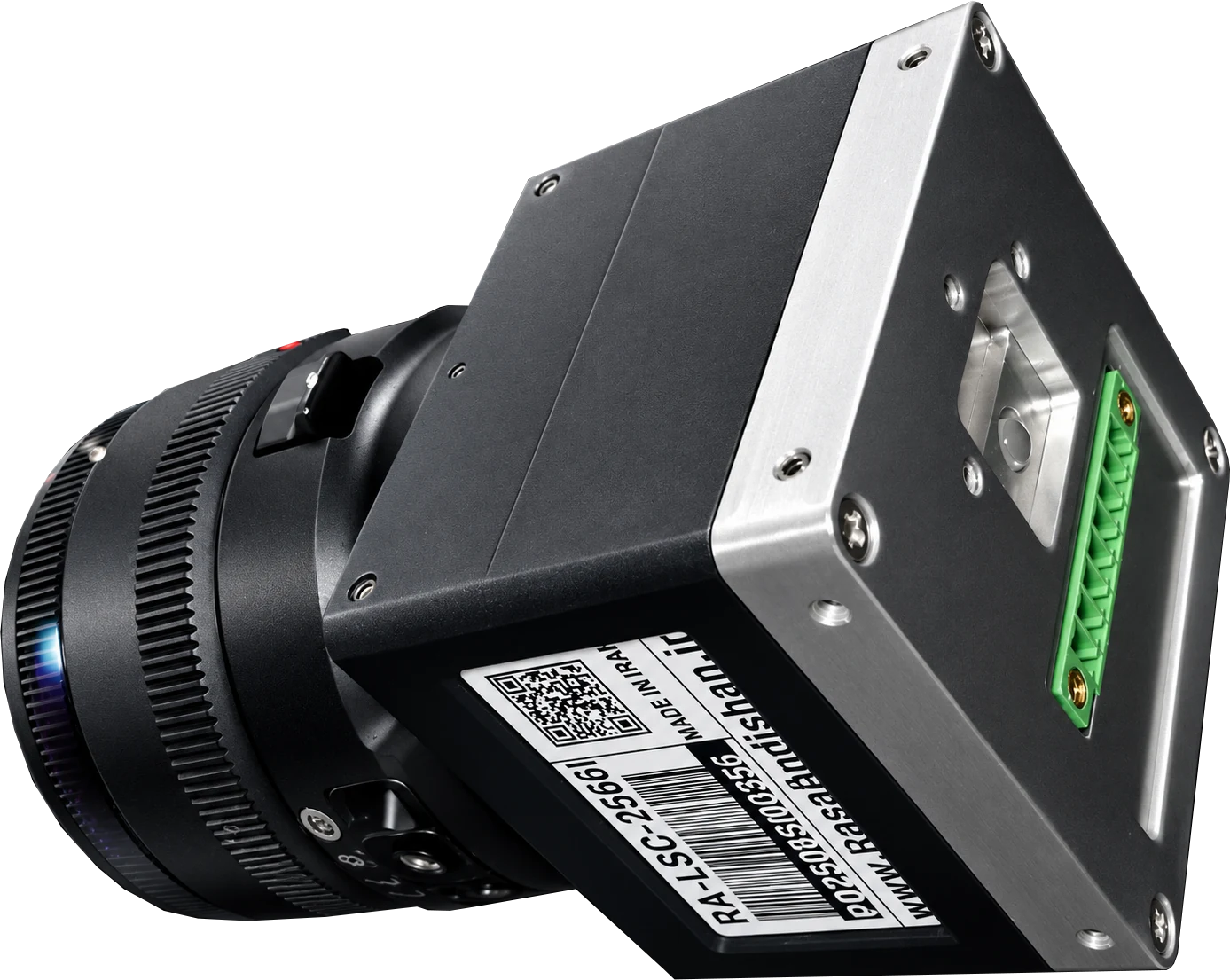
2048-pixel line scan camera, model RA-LSC-0751
Design and construction of the RA-LSC-0751 line scan camera was completed in October 2015. The RA-LSC-0751 is a 2048-pixel monochrome camera with an electronic shutter and a line rate of 2376 Hz. You can use it to scan objects, measure thickness, and measure the width of objects on a conveyor belt. This section shows the spectral response and parametric specifications.
Selection guide
Scanning fast or vibrating objects, even under strong light
When an object moves fast or vibrates, its edges usually smear in the image. We built the RA-LSC-0751 for exactly that case: its electronic shutter cuts the exposure down to 1 μs, independent of the line rate. The sensor has 2,048 pixels of 14 μm × 14 μm on a 28.672 mm active length and runs at 2,376 lines/s. Spectral response is 400 to 1000 nm, and the 6000:1 dynamic range is captured by a 16-bit ADC.
- Sensor
- Linear CCD Array
- Effective pixels
- 1 × 2048
- Pixel size
- 14 μm × 14 μm
- Active length
- 28.672 mm
- Line rate
- 2376 Hz
- Spectral range
- 400 nm to 1000 nm
- Dynamic range
- 6000
- ADC resolution
- 16 bit
- Minimum exposure
- 1 μs
- Maximum exposure
- 35.5 min
With a backlight, the camera measures width 2,376 times per second, a fresh value every 421 μs. In a 150 mm field of view each pixel sees 0.073 mm of the object, and software locates the edge to better than one pixel. Object speed does not matter here, because every line is a separate measurement.
An object moving at 1 m/s travels only 10 μm during a 10 μs exposure. The edge stays sharp in the image, even when the part shakes on the line. The 6000:1 dynamic range helps find the edge correctly on surfaces that reflect unevenly.
Stacking the lines builds a 2D image of a moving object. With a 150 mm field of view each pixel covers 0.073 mm, so to avoid a stretched or squashed image the object should move no faster than about 173 mm/s. The short exposure keeps each line free of blur.
Near hot processes or laser sources, the light is strong enough to saturate a sensor easily. With this camera you can drop the exposure to 1 μs, more than 400 times shorter than the 421 μs line period. The large 14 μm × 14 μm pixel still gives a usable signal at such short exposures.
The camera reports the edge position of a sheet or wire every 421 μs. The 16-bit ADC and offset adjustment in ±512 steps keep the black level steady, so the edge threshold does not drift when the lighting changes.
The key point of this camera is that exposure time is not tied to the line rate. At 2,376 lines/s each line takes about 421 μs, yet the shutter can cut the exposure to 1 μs. Motion blur equals object speed × exposure time. For an object at 1 m/s and a 10 μs exposure that is only 10 μm, smaller than what one pixel sees of the object in any normal field of view. The 14 μm × 14 μm pixel (196 μm²) is large enough that a short exposure does not starve the signal. In a 150 mm field of view each pixel sees 0.073 mm, and the maximum object speed for an undistorted image is about 173 mm/s. Widen the field to 300 mm and both values double. The 6000:1 dynamic range and 16-bit ADC keep the edge visible under uneven light.
The lens focal length is roughly working distance × 28.672 mm ÷ field-of-view width. If the object moves, match its speed to the 2,376 lines/s rate and to what each pixel sees of the object, so the image is not stretched or squashed. For width and edge measurement, a backlight gives the best results. Under strong light, set the exposure far below 421 μs; for static work in low light, exposures up to 35.5 minutes are available. The -I version has an FPGA, gain and offset adjustment, a 16-bit ADC, 480 Mbit/s USB, an analog output and on-board RAM. If 1,905 lines/s is enough and you do not need a short shutter, look at the RA-LSC-0551, which has the same sensor geometry.

| RA-LSC-0751 USB Line Scan Camera Parameters | Specification |
|---|---|
| Sensor | Linear CCD Array |
| Pixel Size | 14 μm x 14 μm |
| Pixel Distance | 14 μm |
| Line Width | 14 μm |
| Effective Pixels | 1X2048 |
| Active Length | 28.672 mm |
| Spectral Range | 400 nm to 1000 nm |
| Max Pixel Frequency | 5 MHz |
| Dynamic Range | 6000 |
| PGA Gain Resolution | 6 V/V - 64Steps |
| Programmable Offset Resolution | 300 mV - 512Steps± |
| Power consumption | 1.5 W |
| External Power | Not Required |
| Operational Temperature Range | −25 to +65 °C |
| Operation Systems | Windows 64-bit And Linux |
| Communication Port | USB2.0 Port |
| Multiple Cameras | Supported |
| Device Driver | Yes |
| Sample Codes | Matlab,LabView,C++,C#,VB.Net,Python |
| Camera Selection Guide | RA-LSC-0751-I |
|---|---|
| Processor | FPGA |
| Gain Adjust | ✓ |
| Offset Adjust | ✓ |
| ADC Resolution | 16 bit |
| USB Speed | 480Mbit/S |
| Analog OutPut | ✓ |
| On Board RAM | ✓ |
| Jitter Order | < 6.3 ns |
| Exposure Min | 1 μs |
| Exposure Max | 35.5 min |
| Exposure Resolution | 1 μs |
| Line Rate | 2376 Hz |
| Operational Temperature Range | −25 to +65 °C |
| Availability | 3Days After Order |