
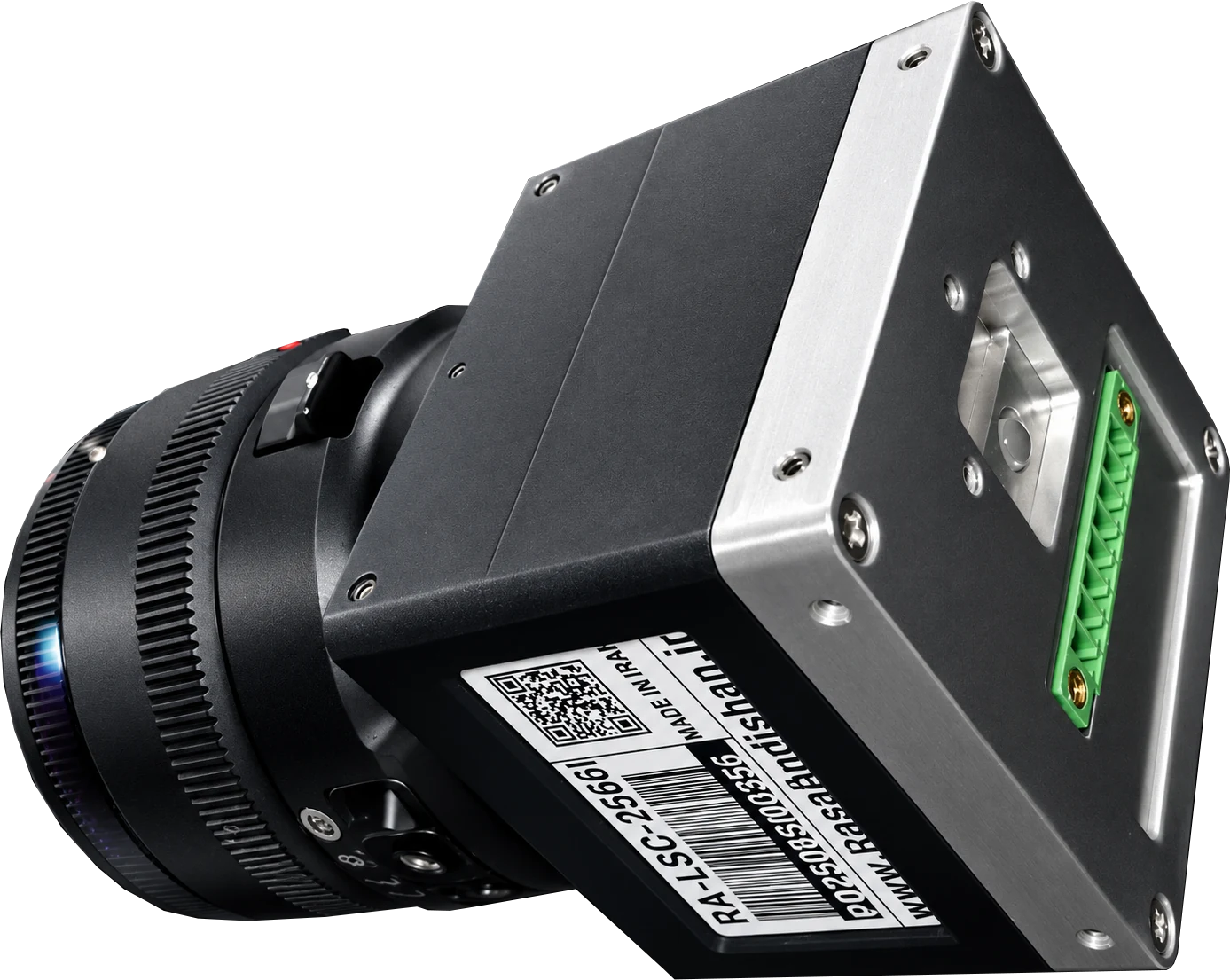
RA-LSC-0551 2048-pixel line scan camera
Design and construction of the RA-LSC-0551 camera was completed in April 2016. The RA-LSC-0551 is a 2048-pixel monochrome line scan camera that runs at 1905 Hz. You can use this camera to scan objects, measure thickness, and measure the width of objects on a conveyor belt. This section shows the spectral response and parametric specifications.
Selection guide
Width, thickness and edge gauging on production lines
Bigger pixels mean more light in less time. The 14 μm × 14 μm pixels of the RA-LSC-0551 have four times the area of a 7 μm pixel, so they collect more signal for the same exposure. We built this camera for continuous measurement of width, thickness and edge position on production lines. The CCD has 2,048 pixels over 28.672 mm and reads 1,905 lines/s. It has a 6000:1 dynamic range, a 16-bit ADC and a 400 to 1000 nm spectral response.
- Sensor
- Linear CCD Array
- Effective pixels
- 1 × 2048
- Pixel size
- 14 μm × 14 μm
- Active length
- 28.672 mm
- Line rate
- 1905.0 Hz
- Spectral range
- 400 nm to 1000 nm
- Dynamic range
- 6000
- ADC resolution
- 16 bit
- Minimum exposure
- 525 μs
- Maximum exposure
- 17.5 min
With back-lighting, the object's shadow falls across the 2,048 pixels. In a 300 mm field of view each pixel sees 0.146 mm of the object, and software processing finds the edge to better than one pixel. With 1,905 measurements per second, you monitor the width without interruption.
Viewing the edge from the side, or using laser triangulation, turns thickness into a shift on the sensor. The 196 μm² pixel collects enough signal even in a 525 μs exposure. The 6000:1 dynamic range keeps the edge visible despite uneven reflections.
As the object moves under the camera, the lines build up a two-dimensional image. In a 300 mm field of view each pixel sees 0.146 mm, so to avoid a stretched or squashed image the object should move no faster than about 279 mm/s. That image is good enough for counting and defect detection.
The sensor responds up to 1000 nm, so near-infrared lighting is an option. On some materials it shows different contrast from visible light. Gain adjustment in 64 steps compensates for the sensor's different response at each wavelength.
The edge position of a sheet or cable is reported every 525 μs. With a 6000:1 dynamic range and 16-bit output, we locate the edge to better than one pixel even against a semi-transparent background.
A 14 μm × 14 μm pixel has an area of 196 μm², four times that of a 7 μm pixel. For the same exposure, collected charge and signal-to-noise ratio rise in the same proportion. That matters at 1,905 lines/s, where each line lasts only 525 μs. On the 28.672 mm sensor, each pixel sees 0.146 mm of the object in a 300 mm field of view and about 0.29 mm in a 600 mm field. For a two-dimensional image the object should advance one pixel per line period. So it should move no faster than about 279 mm/s in a 300 mm field, or 558 mm/s in a 600 mm field. Width gauging has no such limit, because each line is a separate measurement and width changes show up within 1 ms. The 6000:1 dynamic range is about 12.6 bits, and the 16-bit converter covers it fully, so the ADC does not limit intensity resolution.
The focal length is roughly the working distance × 28.672 mm ÷ the field-of-view width. With a 14 μm pitch, the lens doesn't need to be as sharp as one for a 7 μm sensor. The minimum exposure at 1,905 lines/s is 525 μs, so each line collects light over its whole period. Your lighting has to deliver enough signal within half a millisecond. For static work in low light, exposure can go up to 17.5 minutes. The -I version includes an FPGA, gain and offset adjustment, a 16-bit ADC, 480 Mbit/s USB, an analog output and on-board RAM, and operates from -10 to +55 °C. For the same geometry at 2,376 lines/s with exposure from 1 μs, look at the RA-LSC-0751.

| RA-LSC-0551 USB Line Scan Camera Parameters | Specification |
|---|---|
| Sensor | Linear CCD Array |
| Pixel Size | 14 μm x 14 μm |
| Pixel Distance | 14 μm |
| Line Width | 14 μm |
| Effective Pixels | 1X2048 |
| Active Length | 28.672 mm |
| Spectral Range | 400 nm to 1000 nm |
| Max Pixel Frequency | 4 MHz |
| Dynamic Range | 6000 |
| PGA Gain Resolution | 6 V/V - 64Steps |
| Programmable Offset Resolution | 300 mV - 512Steps± |
| Power consumption | 1.5 W |
| External Power | Not Required |
| Operational Temperature Range | −10 to +55 °C |
| Operation Systems | Windows 64-bit And Linux |
| Communication Port | USB2.0 Port |
| Multiple Cameras | Supported |
| Device Driver | Yes |
| Sample Codes | Matlab,LabView,C++,C#,VB.Net,Python |
| Camera Selection Guide | RA-LSC-0551-I |
|---|---|
| Processor | FPGA |
| Gain Adjust | ✓ |
| Offset Adjust | ✓ |
| ADC Resolution | 16 bit |
| USB Speed | 480Mbit/S |
| Analog OutPut | ✓ |
| On Board RAM | ✓ |
| Jitter Order | < 6.3 ns |
| Exposure Min | 525 μs |
| Exposure Max | 17.5 min |
| Exposure Resolution | 1 μs |
| Line Rate | 1905.0 Hz |
| Operational Temperature Range | −10 to +55 °C |
| Availability | 3Days After Order |