
2.3-megapixel camera, model RA-ASC-0234
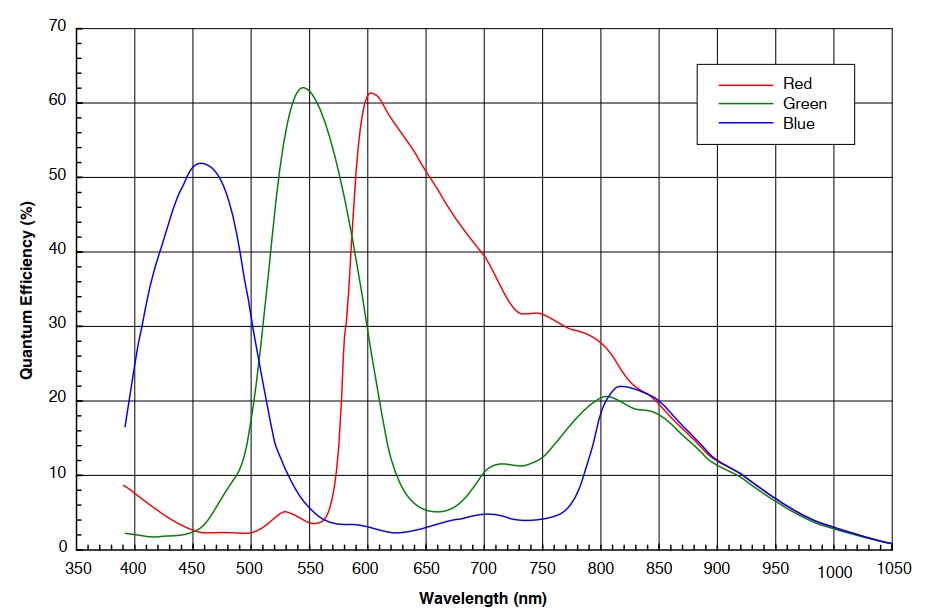
Design and construction of the 2.3-megapixel color RA-ASC-0234-I camera was completed in January 2024. Unlike the ASC-0229 and ASC-0267 models, this camera is not CCD-based; it uses a CMOS sensor. The 2.3-megapixel (1200×1920) RA-ASC-0234 supports external triggering. Its ROI mode also lets you select a specific region of the image and thereby increase the imaging speed. You can use this camera in machine vision, digital image correlation (DIC) and particle image velocimetry (PIV) projects. The spectral response and parametric specifications are shown in this section.
Selection guide
For outdoor and harsh environments, with near-infrared vision
If the camera has to work outdoors in extreme cold or heat, look at the RA-ASC-0234-I. It operates from -40 to +85 °C, and its CMOS sensor responds from 400 to 1100 nm, so it also works with near-infrared light. The sensor has 1920 × 1200 pixels (2.3 megapixels) and sends 8- or 10-bit images at up to 50 frames/s over USB 3.0 at 1.1 Gbit/s. Typical uses are plate reading, production-line inspection and displacement measurement.
- Sensor
- CMOS
- Effective pixels
- H1920 X V1200 = 2.3M
- Pixel size
- 3 μm × 3 μm
- Active imager size
- 5.76 mm(H) * 3.6 mm(V) - 6.8 mm diagonal
- Frame rate
- Max 50 Hz
- Spectral range
- 400 nm to 1100 nm
- ADC resolution
- 8 bit/10 bit
- Interface
- USB3.0 Port
- Operating temperature
- −40 to +85 °C
With a 3 m field of view across one lane, each pixel sees 1.56 mm, and a 300 mm-wide object spans about 190 pixels. At night you can use near-infrared lighting. A vehicle at 10 m/s moves only 200 mm between frames (20 ms).
Over a 200 mm field, each of the 1920 pixels across the image sees 104 μm of the part. The 1.6:1 aspect ratio suits wide conveyors. At 50 frames/s, a part moving at 0.5 m/s is imaged every 10 mm.
In a 60 mm field, each pixel sees 31 μm of the specimen. With 21-pixel subsets on a 10-pixel step, you get about 190 × 118 measurement points. The 10-bit output with 1,024 levels makes image matching more precise than 8 bits.
The 20 ms between frames sets how far the particles move. In a 100 mm field each pixel sees 52 μm, so an 8-pixel shift between frames means 21 mm/s. Near-infrared light sources can be used too.
With a -40 to +85 °C range, you can mount the camera outdoors, next to a furnace or in a cold store without a temperature-controlled housing. Its 3.5 W comes over the same USB 3.0 cable.
The response up to 1100 nm matters most when you choose lighting. Near-infrared light with a matching bandpass filter cuts down ambient light in plate reading and outdoor inspection. The 3 μm pixel is small and needs fairly strong light within each 20 ms frame, especially at the infrared end where silicon becomes less sensitive. On speed: an object at 0.5 m/s moves 10 mm between frames. To avoid blur, the exposure must be short enough that the object moves less than one pixel during it. In 8-bit mode the data stream is about 922 Mbit/s and fits the 1.1 Gbit/s link. In 10-bit mode it reaches about 1,152 Mbit/s and the sustained frame rate drops slightly. Among our area-scan cameras, this is the only one that works below -30 °C.
Focal length is roughly working distance × sensor width ÷ field-of-view width, and this sensor is 5.76 mm wide. A 3 m field from 10 m needs a 19 mm lens, and a 200 mm field from 500 mm needs about 14 mm. The lens must resolve detail near 3 μm across the 6 mm diagonal. The lighting, especially in the near-infrared, must give enough signal within a fraction of the 20 ms frame so that motion blur stays under one pixel. The -I version includes an FPGA, gain and offset adjustment, an 8- or 10-bit converter, 1.1 Gbit/s USB and on-board RAM, and ships 3 days after order. If pixel count matters more to you than frame rate, the RA-ASC-9031-I with 2592 × 1944 pixels is the better fit.
| RA-ASC-0234 USB Area Scan Camera Parameters | Specification |
|---|---|
| Sensor | CMOS |
| Pixel Size | 3 μm x 3 μm |
| Effective Pixels | H1920 X V1200 = 2.3M |
| Total Pixels | H1936 X V1216 = 2.35M |
| Active Imager Size | 5.76 mm(H) * 3.6 mm(V) - 6.8 mm diagonal |
| Spectral Range | 400 nm to 1100 nm |
| Max Pixel Frequency | 125 MHz-OverClocking |
| Power consumption | 3.5 W |
| External Power | Not Required |
| Operational Temperature Range | −40 to +85 °C |
| Operation Systems | Windows 64-bit And Linux |
| Communication Port | USB3.0 Port |
| Multiple Cameras | Supported |
| Device Driver | Yes |
| Sample Codes | Matlab,LabView,C++,C#,VB.Net,Python |
| Camera Selection Guide | RA-ASC-0234-I |
|---|---|
| Processor | FPGA |
| Gain Adjust | ✓ |
| Offset Adjust | ✓ |
| ADC Resolution | 8 bit/10 bit |
| USB Speed | 1.1Gbit/S |
| On Board RAM | ✓ |
| Jitter Order | < 10 ns |
| Frame Rate | Max 50 Hz |
| Operational Temperature Range | −40 to +85 °C |
| Availability | 3Days After Order |