
Article
Photo finish camera
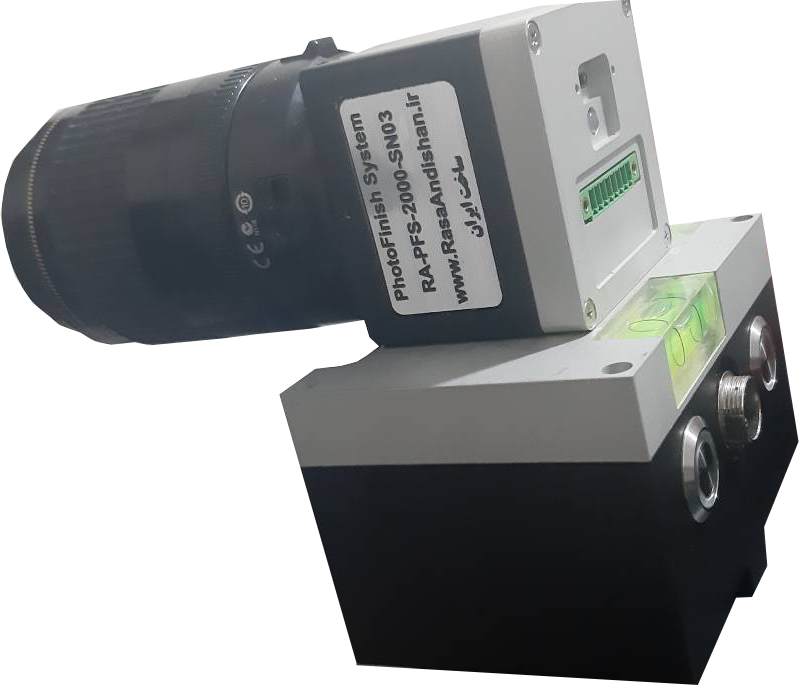
A photo finish camera identifies the winner at the finish line and records the time of every competitor. RasaAndishan Mowj Pardaz designed and built this camera. Our photo finish camera works in cycling, horse racing, athletics, motor racing and rowing. With it you get every competitor's time to within 0.3 milliseconds.
Horse racing organisers in Golestan and Yazd provinces have approved the system's performance. See the models and specifications on the Iranian-made photo finish system page.
History of the photo finish camera
Picking the winner of a close race has long been a real problem. Referees and spectators often argued over the result. These arguments grew heated at high-stakes events such as the Olympics. There, crossing the finish line meant more than a sporting win.
At the 16th Asian Games in Guangzhou, China, this became clearer than ever. Iranian athletes also competed in cycling, athletics and rowing at those Games.
Digital technology solved this problem. A photo finish camera sits on the finish line. It captures about 3000 image lines per second; each line is a very narrow strip of the finish line itself. So even in a shoulder-to-shoulder finish, the image shows who was ahead.
The system's software puts these narrow lines side by side in a fraction of a second. The result is a wide image that looks like a panorama. The judge makes the call from this image. It shows where each competitor was, relative to the others, at the moment they reached the finish line.
All photo finish systems work on the same principle. What technology has improved is speed and accuracy. In 1996 these systems recorded only 1000 images per second. Today that figure has tripled, and accuracy is three times better.
The operator sets the number of lines per second to suit the type and speed of the race. If this number is wrong, the athlete's image comes out stretched or squashed, and the judge struggles to make a call.
A photo finish camera does more than pick first place. If you connect it to the starting pistol, it also records each competitor's time to within 0.3 milliseconds. You then have the finishing order, the time and the average speed of every competitor.
Races with close competition and high speed need this system. Motor racing, motorcycle racing, horse racing, sprinting and cycling are among them.
Where the camera sits on the finish line matters a great deal. If the camera is not precisely aligned, the times and the finishing order come out wrong. That is why we align it with two laser levels. One lies exactly on the finish line and the other is perpendicular to it, along the track.
This puts the camera's line of sight perpendicular to the athletes' path and parallel to the finish line. In effect the camera creates a very narrow virtual curtain on the finish line. Each competitor's first contact with this curtain sets their time.
This technology takes other forms in sport too. In swimming, touch pads at the pool wall record each swimmer's time. In tennis, similar systems help the umpire decide whether the ball was in or out. A tennis ball sometimes travels faster than 200 km/h, too fast for the umpire's eye.
At the World Cup in South Africa, in the match between Germany and England, the referee did not award a goal for a ball that had crossed the goal line. After that, goal-line technology became a serious topic. FIFA invited companies to submit designs, and several sent in their ideas.
We expect photo finish cameras to become smarter in future. They will record and analyse data, and their use will reach beyond sport.
RasaAndishan Mowj Pardaz is the first manufacturer of photo finish systems in Iran. Its photo finish camera is used in athletics, cycling, rowing, motor racing and horse racing. The 1000 model is the basic version and uses a manual M42 lens. The 2000 model was designed to remove the 1000 model's dependence on ambient light. The 3000 model has all the features of the 2000. Setting up the mirror and finish line on this model takes less than 20 seconds.
If you want to compare the models, see the Iranian-made photo finish system page. To learn about the worldwide history of this technology, read the Photo finish article on Wikipedia.