
Article
The concept of F-number
The F-Number, or focal ratio, shows how wide the aperture is open. This opening is expressed relative to the lens's focal length. Below, I look at its effect and how to choose it correctly.
There are a few key words and terms in photography that, once we understand them, help us both to identify and buy a good camera and to know how to set the camera up in different conditions so that the final photo turns out well.

What do f/2.8, f2.0 and similar figures on a camera's specification sheet mean?
Terms such as F-stop or F-number, f-factor, focal factor, focal ratio, f-ratio, and relative aperture all mean the same thing: how wide the camera's aperture opening is. You may be surprised to see so many equivalent terms. Don't worry; the explanations below will make the meaning of all these terms clear.
Defining the F-stop, F-number or focal ratio
I will start with the aperture. The aperture is like the pupil of our eye. The pupil is the black part in the center of the eye. When there is a lot of light, the muscles around it make it narrow and small. When there is little light, the pupil gets larger. The larger the pupil, the more light it takes in.
A camera diaphragm looks something like the figure below. It contains several blade-like pieces that increase or decrease the amount of light passing through:
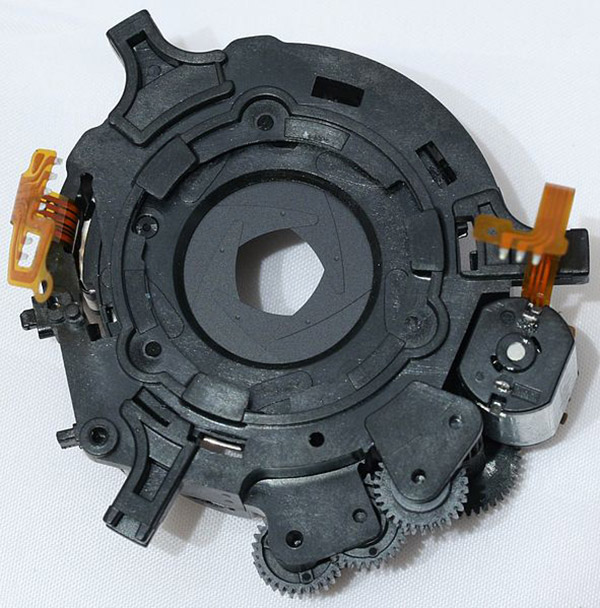
So in a camera, too, we can make a photo darker or brighter by narrowing or widening the aperture.
We briefly explain the exposure triangle later in this article. For now, just know that the exposure time can also be increased or decreased. The combination of how long light passes through and how wide the aperture is determines how bright or dark the image is. In other words, a quantity called the exposure value (EV) combines these two factors, exposure time and aperture, into a single number.
In photography, it is more useful to express how far the aperture is open in relation to the lens's focal length — hence the term relative aperture, where “relative”, the diameter is expressed relative to the focal length.
Put simply, the focal point of a lens is where the rays converge and meet. For example, a magnifying glass concentrates sunlight at its focal point, and you can use that very spot to set paper alight! Note that the precise definition of the focal point is as follows:
The focal point of a lens or a non-flat mirror is the point at which rays emitted from objects at physical infinity converge.
For example, if a lens has a focal length of 100 mm and the aperture has a maximum diameter of 25 mm, we say the lens is f/4.
Therefore:
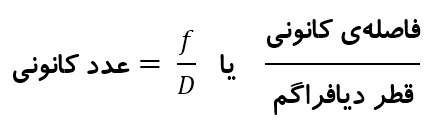
So the f-number equals the focal length divided by the aperture diameter: 100 ÷ 25 = 4, that is, f/4.
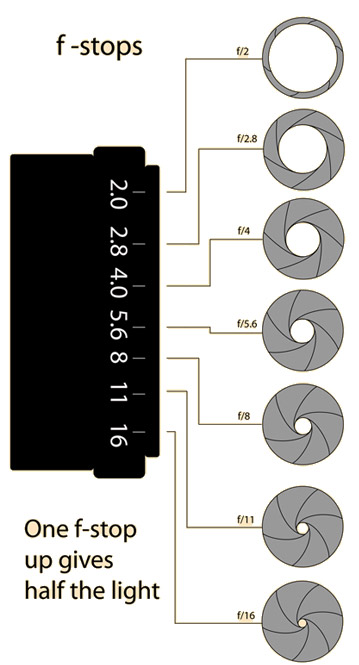
The focal ratio, or relative aperture, starts at f/1.4. With each step (one stop), the f-number is multiplied by about 1.4 (the square root of 2) and the aperture area is halved. For example, after f/1.4 comes f/2. The aperture area at f/2 is about half the area at f/1.4, so the light reaching the sensor is also halved.
If you multiply the f-number by the square root of 2 (about 1.4), you get the next value, f/2.8. In the same way you get f/4, f/5.6 and f/8.
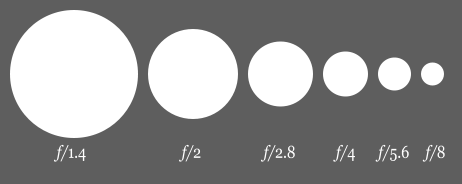
Compared with f/2, f/8 has 16 times less area and a diameter 4 times narrower. So if you want the brightness of the final image to stay the same, you must make the exposure time (the exposure I mentioned earlier) 16 times longer.
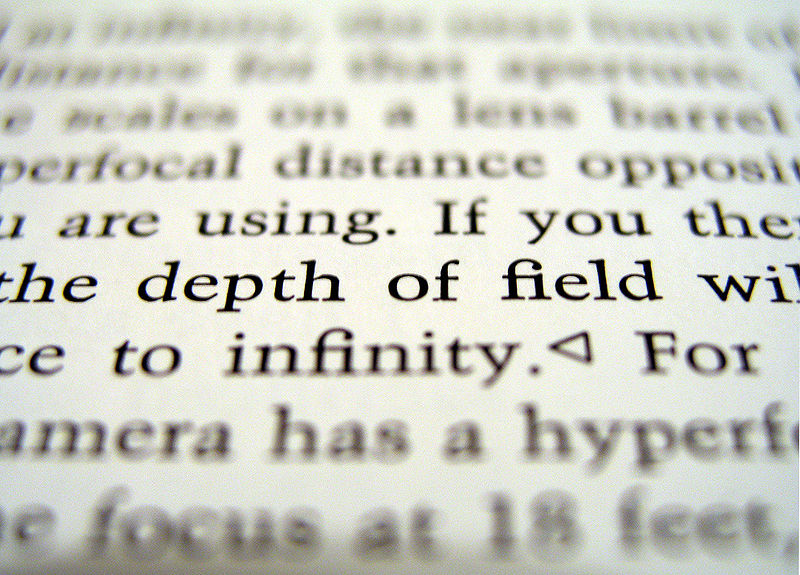
The more the aperture is closed, the more concentrated the rays passing through the lens become. In other words, the more the aperture is closed, the narrower the bundle of rays, and points that are not exactly in focus form a smaller circle on the sensor. As a result, a greater range in front of and behind the subject looks sharp.
In the real world, if a point is at a specific distance from the camera, its image forms exactly on the sensor surface and appears as a point on the sensor. If it is not at that distance, it is imaged as a large circle. Put simply, the edges of objects that are out of focus become completely blurred.

Suppose you open the aperture, for example to F5.6 in the image below. In this case some rays converge in front of the focal point and others behind it. Then only objects whose reflected light rays converge on the sensor surface are in focus.
Now if you shoot at F22, the blur spot of near and far objects becomes so small that most of the scene looks sharp. If the sensor is also at the focal point, everything looks sharp.
Sometimes a photographer wants to separate the subject from the background; in that case a wide aperture is desirable. Conversely, if they want to photograph beautiful landscapes fully in focus, they need an excellent camera: one that can take a good, low-noise photo even with an aperture as small as F22.
When you open the aperture fully, the subject separates from the background. The result is interesting images. Whether you use this mode or not depends on the situation and the subject. In these photos only part of the scene in front of the camera is sharp. Look at examples of the bokeh effect in the two images below:

Lens speed and its relation to the f-number
The wider the aperture of a lens or of a camera's optical assembly, the faster and more easily it gathers light, and we say the lens is faster. The reverse is also true: lenses with a small aperture and a large depth of field are slower.
To shoot with a small aperture, the camera must be of high quality, and the sensor and image processor must be able to produce a good photo in a short time. Ordinary cameras cannot do this. In these cameras, if you narrow the aperture (that is, increase the focal ratio), little light reaches the sensor. As a result, the final photo is dark or noisy, or you have to lengthen the exposure to compensate, which raises the risk of camera shake and leaves relatively high noise in the image.
What is a fast lens and what makes it special?
"Fast lens" is a term for lenses with a large relative aperture, that is, a low focal ratio such as 1.4 or 2.0. These lenses have their own specific applications.
For high-quality lenses and professional cinema cameras, another quantity called the T-stop is usually used.
The T-stop is the F-stop with the lens's light transmission also taken into account.
Ordinary lenses transmit between 60 and 90 percent of the light. Take 60 percent. Suppose a lens has an f-number of f/2.0 and a light transmission of 60 percent. To get the T-stop, divide the f-number by the square root of the transmission: 2.0 divided by the square root of 0.6 (about 0.77). So in this example the T-stop is about T2.6.
Some professional cameras are graduated and calibrated in T-stops.
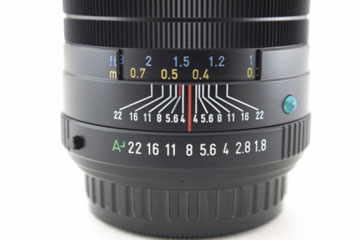
As mentioned, on professional lenses these numbers are marked on the lens barrel. By rotating the rings you can select the focal ratio you want. The image below shows an example of different f-stops and the scale on a lens:
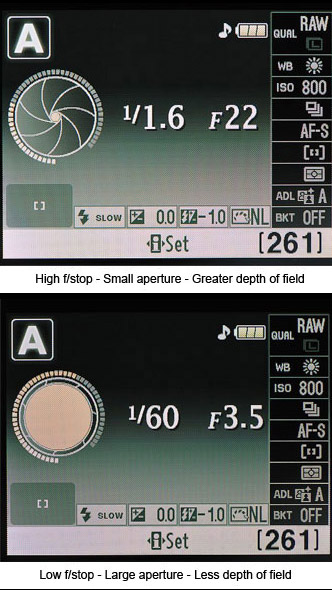
In ordinary and compact cameras, most of this is done in software. The camera may also have a rotary knob, similar to a volume control, that opens and closes the aperture.
Here is an example of the software method:
Aperture Priority mode
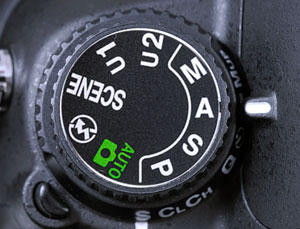
Some semi-professional cameras also have an aperture priority shooting mode, marked A or AV. In this mode the camera chooses the shutter speed intelligently but leaves the choice of aperture to us.
How wide the aperture should be depends on the ambient light intensity, the exposure time and the light sensitivity, or ISO. That is why you should use what is called the exposure triangle.
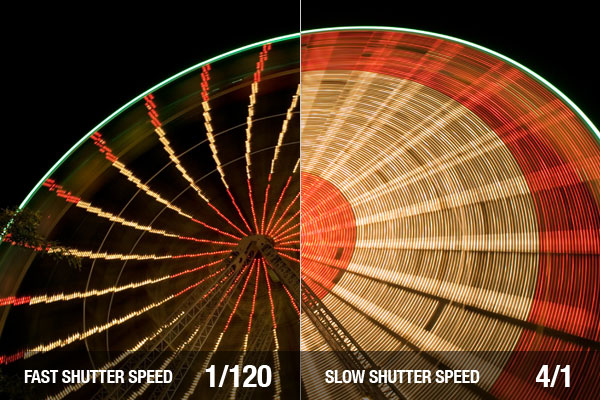
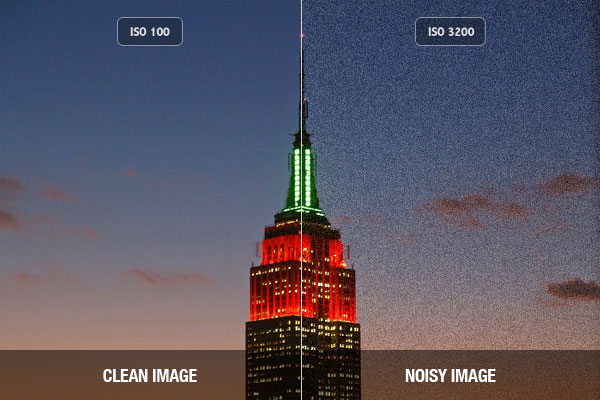
I will explain shutter speed and sensitivity in more detail later, but for now look at the images and brief explanations to see how the three factors of the exposure triangle affect the final photo.
If the subject is moving fast or the camera is shaking a lot, a high shutter speed is desirable. The exposure is made in a short time, so there is no shake or blur in the image:
ISO sensitivity determines how strongly the camera amplifies the signals produced by light absorbed in the sensor. A high ISO means the camera amplifies the sensor's weak signal more. Noise is amplified along with the signal, and because little light has been collected, the share of noise in the image becomes more visible. In fact, not all of the signal is real. The sensor is a kind of photodiode or light-sensitive material, and its inherent errors also affect the signal produced by each pixel. A high ISO is not good, but when light is low, you have no choice but to use a high ISO.
The Sunny 16 rule of thumb
On a sunny day the ambient light is relatively strong. On such a day, set the camera's ISO to 200 and the shutter speed to 1/200 second. With an aperture of f/16 you will then get a good-quality photo.
Source: Intotek
The F-number is not just a photography concept. In industrial cameras too, all the light that reaches the sensor passes through the lens. If the lens is not suitable, even a very high-resolution camera will not give a good image. So when you choose a lens, pay attention to its F-number and focal length.
In a lens, a part called the iris controls how much light passes through. In some lenses the iris is automatic. In others, you set it by hand. You can read answers to questions about lenses, angle of view and depth of field on the Frequently asked questions page. For a more detailed read, see the F-number article on Wikipedia.