
5-megapixel camera, model RA-ASC-9031
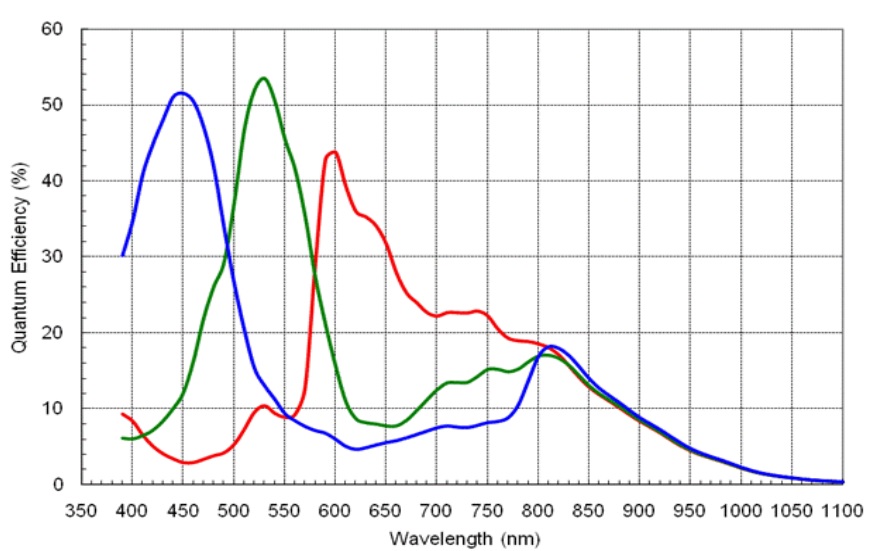
Design and construction of the 5-megapixel RA-ASC-9031 camera was completed in July 2020. Unlike the ASC-0229 and ASC-0267 models, this camera is not CCD-based; it uses a CMOS sensor. External triggering and AOI mode are key features of this camera. With AOI mode you can select a specific region of the image and thereby increase the imaging speed. You can use the 5-megapixel (1944×2592) RA-ASC-9031 in machine vision projects, digital image correlation (DIC) and laboratory image processing applications. The spectral response and parametric specifications are shown in this section.
Selection guide
For precise measurement and detailed inspection of stationary parts
This model has the smallest pixel among our area-scan cameras: 2.2 μm. The RA-ASC-9031-I carries a 2592 × 1944 CMOS sensor (5 megapixels) on a 5.70 mm × 4.28 mm imager. It runs at up to 20 frames/s with 8- or 12-bit output and sends data over USB 3.0. It does its best work in dimensional measurement, inspection of stationary parts and DIC in slow tests.
- Sensor
- CMOS
- Effective pixels
- H2592 X V1944 = 5M
- Pixel size
- 2.2 μm × 2.2 μm
- Active imager size
- 5.70 mm(H) * 4.28 mm(V) - 7.13 mm diagonal
- Frame rate
- Max 20 Hz
- Spectral range
- 400 nm to 700 nm
- ADC resolution
- 8 bit/12 bit
- Interface
- USB3.0 Port
- Operating temperature
- −30 to +70 °C
With a 26 mm field of view, each pixel sees 10 μm of the specimen. 21-pixel subsets on a 10-pixel step give about 257 × 192 measurement points. The 12-bit output with 4,096 levels helps you find displacement to better than one pixel.
Behind a 4× objective, the camera sees 1.43 mm × 1.07 mm of the specimen in one frame, and each pixel corresponds to 0.55 μm on the sample. With 5 megapixels you capture the whole field in a single image, with no stitching.
On a 100 mm × 75 mm circuit board, each pixel sees 39 μm in both directions. That is enough to check pads smaller than 0.2 mm. Each full image is ready in 50 ms.
In a 50 mm field, each of the 2592 pixels across the image covers 19 μm. Software edge detection on 12-bit data finds edges to better than one pixel, bringing measurement uncertainty down to a fraction of that. The scale is the same on both axes.
With 8- or 12-bit output and on-board RAM, you can record short sequences at full resolution. Drivers for 64-bit Windows and Linux, with sample code for Matlab, LabView, C++, C#, VB.Net and Python, get you started on day one.
The 2.2 μm pixel cuts both ways. In a given field of view you see detail 1.7 times finer than with 3.75 μm pixels and 2.2 times finer than with 4.8 μm pixels. On the other hand, each pixel collects less light, so the scene needs more of it. The 20 frames/s limit, 50 ms between frames, makes this a camera for static or very slow scenes. At full rate in 8-bit mode the sensor produces about 806 Mbit/s. This data reaches the PC over USB 3.0, and the on-board RAM also buffers short bursts. The 12-bit output with 4,096 levels records edge slopes more precisely, which helps locate edges to better than one pixel.
Focal length is roughly working distance × sensor width ÷ field-of-view width. With a 5.70 mm sensor, a 50 mm field at 300 mm needs a 34 mm lens. With this camera, though, lens quality matters more than focal length. The lens must resolve detail near 2.2 μm across the 7.13 mm diagonal, or the small pixels are wasted. The lighting must give the small pixels enough signal within each 50 ms frame and, for measurement, be uniform and flicker-free. The -I version includes an FPGA, gain and offset adjustment, an 8- or 12-bit converter, USB 3.0 and on-board RAM, runs from -30 to +70 °C and ships 3 days after order. For fast events at a similar pixel count, look at the RA-ASC-5000-I at 60 frames/s with 4.8 μm pixels.
| RA-ASC-9031 USB Area Scan Camera Parameters | Specification |
|---|---|
| Sensor | CMOS |
| Pixel Size | 2.2 μm x 2.2 μm |
| Effective Pixels | H2592 X V1944 = 5M |
| Total Pixels | H2752 X V2004 = 5.5M |
| Active Imager Size | 5.70 mm(H) * 4.28 mm(V) - 7.13 mm diagonal |
| Spectral Range | 400 nm to 700 nm |
| Power consumption | 3 W |
| External Power | Not Required |
| Operational Temperature Range | −30 to +70 °C |
| Operation Systems | Windows 64-bit And Linux |
| Communication Port | USB3.0 Port |
| Multiple Cameras | Supported |
| Device Driver | Yes |
| Sample Codes | Matlab,LabView,C++,C#,VB.Net,Python |
| Camera Selection Guide | RA-ASC-9031-I |
|---|---|
| Processor | FPGA |
| Gain Adjust | ✓ |
| Offset Adjust | ✓ |
| ADC Resolution | 8 bit/12 bit |
| On Board RAM | ✓ |
| Jitter Order | < 10 ns |
| Frame Rate | Max 20 Hz |
| Operational Temperature Range | −30 to +70 °C |
| Availability | 3Days After Order |