
1.2-megapixel camera, model RA-ASC-0134
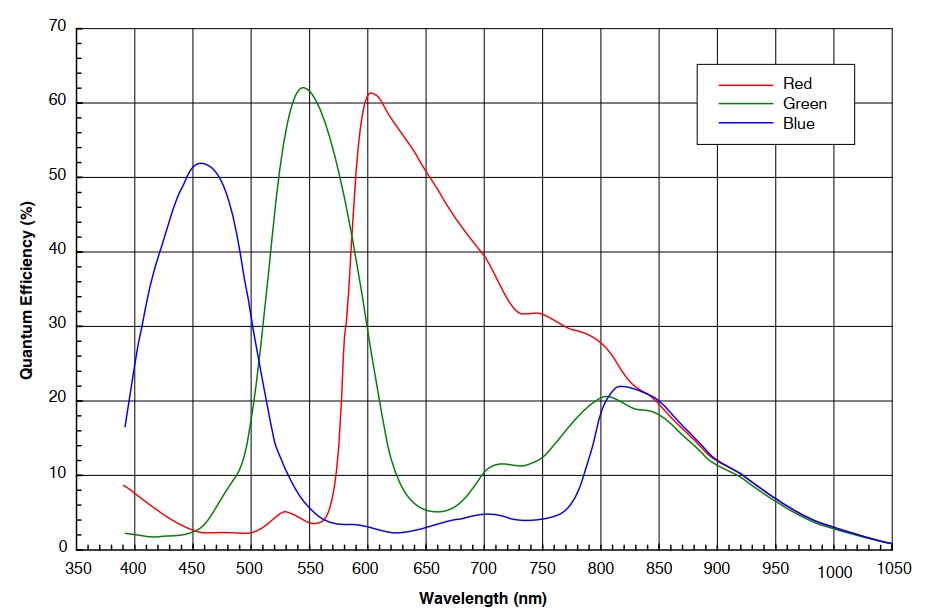
Design and construction of the RA-ASC-0134-I area scan camera was completed in April 2022. Unlike the ASC-0229 and ASC-0267 models, this camera is not CCD-based; it uses a CMOS sensor. The 1.2-megapixel (1280×964) RA-ASC-0134 supports external triggering. This camera also has an ROI mode, which lets you select a specific region of the image and thereby increase the imaging speed. The spectral response and parametric specifications are shown in this section.
Selection guide
For inspecting moving parts, guiding robots and reading codes
We built this camera for production lines, where parts don't stand still. The RA-ASC-0134-I has a 1280 × 964 CMOS sensor, runs at up to 72 frames/s and sends 8- or 12-bit data over USB 3.0 at 740 Mbit/s. It works from -30 to +70 °C and draws only 3 W. Its main jobs are conveyor inspection, part localisation and barcode reading.
- Sensor
- CMOS
- Effective pixels
- H1280 X V964 = 1.2M
- Pixel size
- 3.75 μm × 3.75 μm
- Active imager size
- 4.80 mm(H) * 3.6 mm(V) - 6.8 mm diagonal
- Frame rate
- Max 72 Hz
- Spectral range
- 400 nm to 700 nm
- ADC resolution
- 8 bit/12 bit
- Interface
- USB3.0 Port
- Operating temperature
- −30 to +70 °C
With a 60 mm field of view, each pixel sees 47 μm of the part, and frames come every 13.9 ms. A part moving at 0.3 m/s travels only 4.2 mm between frames. So you get several images of every part as it passes the camera.
At 72 frames/s, less than 14 ms passes between a part arriving and the first image. The 3.75 μm pixels are the same size in both directions, which keeps the conversion from image to robot coordinates simple.
For a code whose narrowest bar is 0.25 mm, each pixel should see about 80 μm of the code or less. A 100 mm field across 1280 pixels gets you there. The 8-bit output at full frame rate is enough for thresholding the code.
With 13.9 ms between frames, an event lasting a few tens of milliseconds shows up in several consecutive frames. On-board RAM holds the frames until they go out over the 740 Mbit/s link.
The 12-bit output has 4,096 brightness levels, useful for testing algorithms that depend on small intensity differences. Drivers for 64-bit Windows and Linux ship with sample code for Matlab, LabView, C++, C#, VB.Net and Python.
Check your line speed with an example. With a 60 mm field and a conveyor at 0.3 m/s, a part moves 4.2 mm between frames and is captured about 14 times. The second issue is motion blur. For sharp edges, the part must not move more than one pixel, here 47 μm, during the exposure. So the exposure has to be a small fraction of the 13.9 ms between frames, and the 3.75 μm pixel needs plenty of light in that short time. In 8-bit mode the data stream is about 711 Mbit/s, which fits the 740 Mbit/s link. In 12-bit mode it rises to about 1,066 Mbit/s, so either the frame rate drops or the on-board RAM buffers frames. The imager has a 6 mm diagonal, so small standard lenses are enough. The -30 to +70 °C range lets you install it where there is no temperature control.
Focal length is roughly working distance × sensor width ÷ field-of-view width. The sensor is 4.80 mm wide, so a 60 mm field at 250 mm needs a 20 mm lens. The lens must resolve detail close to the 3.75 μm pixel across the whole 6 mm diagonal. Use strong lighting so that a short exposure still gives enough signal and motion blur stays under one pixel. The -I version includes an FPGA, gain and offset adjustment, an 8- or 12-bit converter, 740 Mbit/s USB and on-board RAM, and ships 3 days after order. If you need more pixels or response up to 1100 nm, look at the RA-ASC-0234-I with 1920 × 1200 pixels at 50 frames/s.
| RA-ASC-0134 USB Area Scan Camera Parameters | Specification |
|---|---|
| Sensor | CMOS |
| Pixel Size | 3.75 μm x 3.75 μm |
| Effective Pixels | H1280 X V964 = 1.2M |
| Total Pixels | H1412 X V1028 = 1.45M |
| Active Imager Size | 4.80 mm(H) * 3.6 mm(V) - 6.8 mm diagonal |
| Spectral Range | 400 nm to 700 nm |
| Max Pixel Frequency | 100 MHz-OverClocking |
| Power consumption | 3 W |
| External Power | Not Required |
| Operational Temperature Range | −30 to +70 °C |
| Operation Systems | Windows 64-bit And Linux |
| Communication Port | USB3.0 Port |
| Multiple Cameras | Supported |
| Device Driver | Yes |
| Sample Codes | Matlab,LabView,C++,C#,VB.Net,Python |
| Camera Selection Guide | RA-ASC-0134-I |
|---|---|
| Processor | FPGA |
| Gain Adjust | ✓ |
| Offset Adjust | ✓ |
| ADC Resolution | 8 bit/12 bit |
| USB Speed | 740Mbit/S |
| On Board RAM | ✓ |
| Jitter Order | < 10 ns |
| Frame Rate | Max 72 Hz |
| Operational Temperature Range | −30 to +70 °C |
| Availability | 3Days After Order |