
5150-pixel line scan camera, model RA-LSC-0553
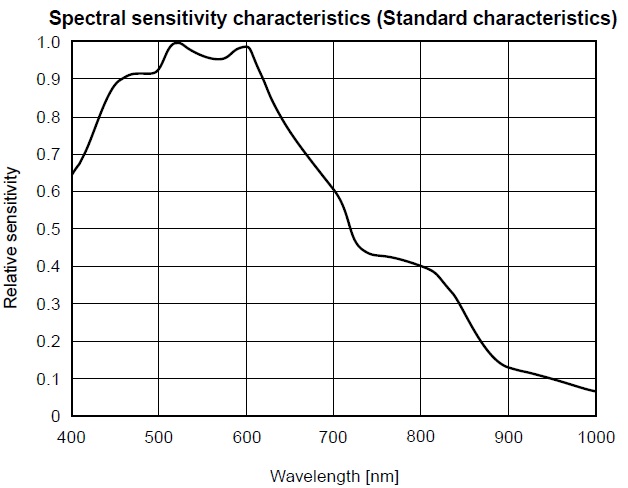
Design and construction of the RA-LSC-0553 camera was completed in late March 2016. The RA-LSC-0553 is a 5150-pixel monochrome line scan camera with a line rate of 951 Hz. You can use it to scan objects, measure thickness, and measure the width of objects on a conveyor belt. This section shows the spectral response and parametric specifications.
Selection guide
Precise width gauging and scanning, including blue and near-UV light
Many line-scan cameras respond only from 400 nm up. The RA-LSC-0553 starts at 350 nm and runs to 900 nm, so you can also inspect with blue and near-ultraviolet light. Its sensor has 5,150 pixels of 7 μm × 7 μm over 36.05 mm, and it is designed for precise width and thickness gauging of sheet and web. It runs at 951.5 lines/s with a 16-bit ADC, and exposure is adjustable from 1,051 μs to 14.5 minutes in 1 μs steps.
- Sensor
- Linear CCD Array
- Effective pixels
- 1 × 5150
- Pixel size
- 7 μm × 7 μm
- Active length
- 36.05 mm
- Line rate
- 951.5 Hz
- Spectral range
- 350 nm to 900 nm
- ADC resolution
- 16 bit
- Minimum exposure
- 1051 μs
- Maximum exposure
- 14.5 min
- Interface
- USB2.0 Port
The 5,150 pixels span the object, and in a 250 mm field of view each pixel sees 0.049 mm of it. With back-lighting and software processing, we find the edge to better than one pixel. You get 951 measurements every second.
With a side view or laser triangulation, thickness becomes a position on the sensor. In a small field of view the 7 μm pitch gives fine resolution. In a 50 mm field, for example, each pixel sees about 0.01 mm.
As the object moves, the lines build up a two-dimensional image. In a 250 mm field of view the object should move no faster than about 46 mm/s to avoid a stretched or squashed image. Defects down to about one pixel, roughly 0.049 mm, can then be seen.
Because the sensor responds from 350 nm, you can light the part with blue or near-ultraviolet sources. Shorter wavelengths scatter more at the surface, so fine scratches show up more clearly. In fluorescence inspection, the excitation light also falls within the sensor's range.
With 5,150 points across the width, each pixel sees 0.058 mm of a 300 mm wide document. The 16-bit ADC and offset adjustment in ±512 steps let you capture the gray tones of film without clipping the dark areas.
5,150 pixels on a 7 μm pitch give a 36.05 mm sensor and dense sampling of the object: in a 250 mm field each pixel sees 0.049 mm, and in a 100 mm field about 0.019 mm. For a two-dimensional image the object should advance exactly one pixel per line period. At 951.5 lines/s that means at most about 46 mm/s in a 250 mm field and 18 mm/s in a 100 mm field. For width gauging, speed doesn't matter, because each line is a separate measurement. The 7 μm pixel is small (49 μm²) and the 1,051 μs minimum exposure equals the line period. The whole period goes into collecting light, so choose your light intensity with that in mind. Response from 350 nm means blue and near-ultraviolet light, which gives little signal on sensors that start at 400 nm, is usable here.
The lens must cover the full 36.05 mm sensor without light fall-off at the ends. The focal length is roughly the working distance × 36.05 mm ÷ the object width. If you work with 350 to 400 nm light, check that the lens transmits those wavelengths. At 951.5 lines/s the 1,051 μs minimum exposure equals the line period. At full speed exposure stays fixed at about 1 ms, so provide enough light. The -I version includes an FPGA, gain and offset adjustment, a 16-bit ADC, 480 Mbit/s USB, an analog output and on-board RAM, and operates from -10 to +60 °C. For a wider field at the same pitch, see the RA-LSC-0532 with 7,500 pixels and 52.5 mm.
| RA-LSC-0553 USB Line Scan Camera Parameters | Specification |
|---|---|
| Sensor | Linear CCD Array |
| Pixel Size | 7 μm x 7 μm |
| Pixel Distance | 7 μm |
| Line Width | 7 μm |
| Effective Pixels | 1X5150 |
| Active Length | 36.05 mm |
| Spectral Range | 350 nm to 900 nm |
| Max Pixel Frequency | 5 MHz |
| Dynamic Range | - |
| PGA Gain Resolution | 6 V/V - 64Steps |
| Programmable Offset Resolution | 300 mV - 512Steps± |
| Power consumption | 1.5 W |
| External Power | Not Required |
| Operational Temperature Range | −10 to +60 °C |
| Operation Systems | Windows 64-bit And Linux |
| Communication Port | USB2.0 Port |
| Multiple Cameras | Supported |
| Device Driver | Yes |
| Sample Codes | Matlab,LabView,C++,C#,VB.Net,Python |
| Camera Selection Guide | RA-LSC-0553-I |
|---|---|
| Processor | FPGA |
| Gain Adjust | ✓ |
| Offset Adjust | ✓ |
| ADC Resolution | 16 bit |
| USB Speed | 480Mbit/S |
| Analog OutPut | ✓ |
| On Board RAM | ✓ |
| Jitter Order | < 6.3 ns |
| Exposure Min | 1051 μs |
| Exposure Max | 14.5 min |
| Exposure Resolution | 1 μs |
| Line Rate | 951.5 Hz |
| Operational Temperature Range | −10 to +60 °C |
| Availability | 3Days After Order |
RasaAndishan Mowj Pardaz officially began operating in 2012. The company's main field of activity is the design and manufacture of electro-optical detector systems. Its achievements include designing and building Iran's first line scan camera, first domestic seam tracking system and first flying saw controller for pipes and profiles.
You can buy RasaAndishan products in person or remotely. If you prefer to buy in person, visit the company's office. We will test and set up the product you want right there, and you take it with you after paying in full.
For customers who have bought from RasaAndishan before, or who prefer to receive their product remotely, online purchasing is available. You can buy all of the company's products online, including line scan and area scan cameras, the weld seam tracking system, and the flying shear system for pipes and profiles. Orders are shipped to customers as quickly as possible.
All of the company's products come with a two-week trial period. If you are not satisfied with the product you bought, return it; once we receive the product, your payment is refunded in full.
This website is owned by RasaAndishan. To further earn the trust of our valued customers, RasaAndishan has obtained the e-Namad electronic trust seal for online businesses.