
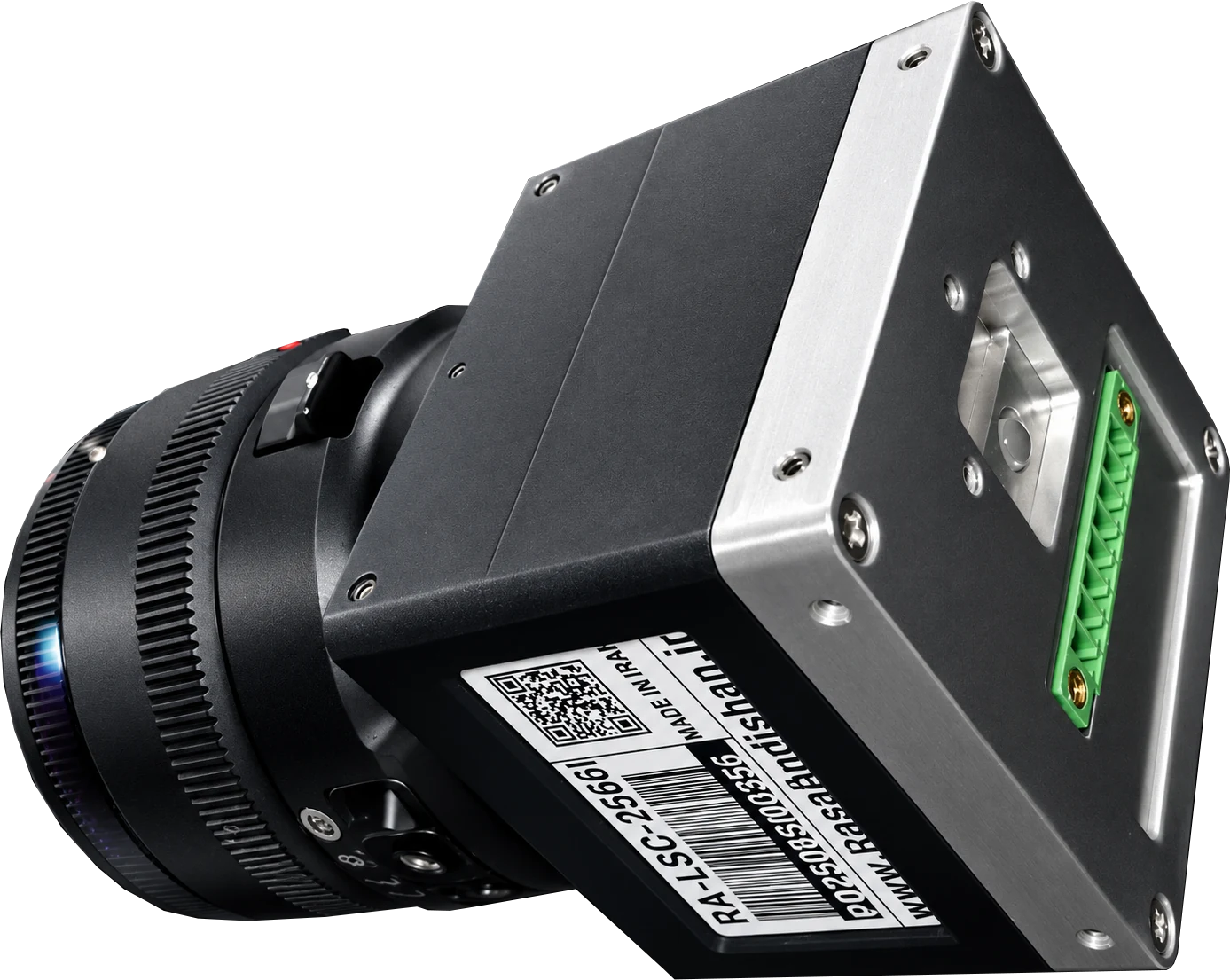
7500-pixel line scan camera, model RA-LSC-0532
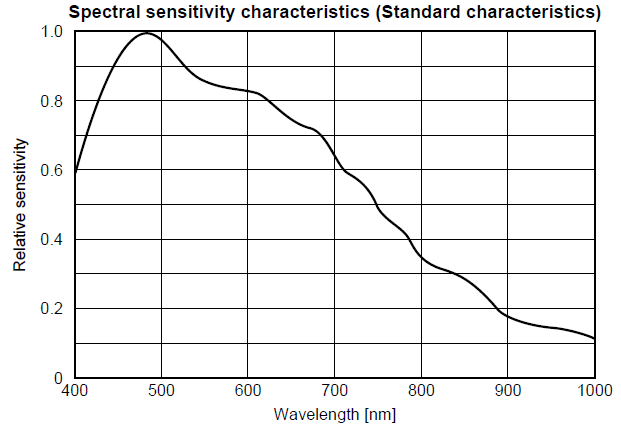
Design and construction of the RA-LSC-0532 line scan camera was completed in April 2016. The RA-LSC-0532 is a 7500-pixel monochrome camera that runs at 1050 Hz. You can use this camera to scan objects and measure the width of objects on a conveyor belt. This section shows the camera's spectral response and parametric specifications.
Selection guide
Wide-format scanning and width gauging at better than 0.1 mm
When the object is wide and you don't want to give up detail, 7,500 pixels make the difference. The RA-LSC-0532 is a linear CCD camera with 7,500 pixels of 7 μm × 7 μm (2 × 3,750) on a 52.5 mm sensor, giving better than 0.1 mm per pixel even over wide fields. We built it for width gauging on conveyors and for scanning sheet, web, documents and film. It runs at 1,050.5 lines/s with a 16-bit ADC, and its 400 to 1000 nm response covers both visible and near-infrared light.
- Sensor
- Linear CCD Array
- Effective pixels
- 2 × 3750=7500
- Pixel size
- 7 μm × 7 μm
- Active length
- 52.5 mm
- Line rate
- 1050.5 Hz
- Spectral range
- 400 nm to 1000 nm
- Dynamic range
- ---
- ADC resolution
- 16 bit
- Minimum exposure
- 952 μs
- Maximum exposure
- 17.5 min
With back-lighting, the object's shadow falls across the 7,500 pixels. In a 600 mm field of view each pixel sees 0.08 mm of the object. Software processing finds the edges to better than one pixel, and the width is reported 1,050 times per second.
As the sheet moves under the camera, the lines stack up into a two-dimensional image. In a 600 mm field of view each pixel sees 0.08 mm of the object. To keep the image from being stretched or squashed, the sheet should move no faster than about 84 mm/s.
With 7,500 points across the width, small text and fine lines stay legible on large documents. On a 900 mm wide drawing each pixel sees 0.12 mm of the paper. The 400 to 1000 nm response lets you choose visible or near-infrared lighting.
The sensor responds up to 1000 nm, so you can use near-infrared light. It is invisible to operators and passes through some coatings and pigments. Gain adjustment in 64 steps makes up for the sensor's different response at different wavelengths.
The 16-bit ADC gives 65,536 brightness levels. Offset adjustment in ±512 steps fixes the black level before conversion. Dark and bright areas of a glossy or textured surface are then captured correctly in the same line.
With 7,500 pixels on a 7 μm pitch, the sensor is 52.5 mm long. That length lets you widen the field of view without losing detail: in a 600 mm field each pixel sees 0.08 mm of the object, and in a 1.2 m field about 0.16 mm. For a two-dimensional image, the object should advance exactly one pixel per line period. At 1,050.5 lines/s that means at most about 84 mm/s in a 600 mm field and 168 mm/s in a 1.2 m field. For width gauging, belt speed doesn't matter, because each line is a separate measurement and you get 1,050 of them per second. The 7 μm pixel is small (49 μm²) and the 952 μs minimum exposure equals the line period, so the light must be strong enough to build up signal in under 1 ms. The 16-bit ADC with gain and offset control helps locate edges to better than one pixel even under uneven lighting.
The sensor is 52.5 mm long, so choose a lens whose image circle covers it fully, and check for light fall-off at both ends. The focal length is roughly the working distance × 52.5 mm ÷ the object width. The 952 μs minimum exposure is almost equal to the line period at 1,050.5 lines/s. At full speed exposure is effectively fixed, and light intensity is the only thing you can adjust. The -I version includes an FPGA, gain and offset adjustment, a 16-bit ADC, 480 Mbit/s USB, an analog output and on-board RAM. For a narrower field or response from 350 nm, look at the RA-LSC-0553: same pixel pitch, 5,150 pixels, 36.05 mm.
| RA-LSC-0532 USB Line Scan Camera Parameters | Specification |
|---|---|
| Sensor | Linear CCD Array |
| Pixel Size | 7 μm x 7 μm |
| Pixel Distance | 7 μm |
| Line Width | 7 μm |
| Effective Pixels | 2X3750=7500 |
| Active Length | 52.5 mm |
| Spectral Range | 400 nm to 1000 nm |
| Max Pixel Frequency | 4 MHz |
| Dynamic Range | --- |
| PGA Gain Resolution | 6 V/V - 64Steps |
| Programmable Offset Resolution | 300 mV - 512Steps± |
| Power consumption | 1.5 W |
| External Power | Not Required |
| Operational Temperature Range | −10 to +55 °C |
| Operation Systems | Windows 64-bit And Linux |
| Communication Port | USB2.0 Port |
| Multiple Cameras | Supported |
| Device Driver | Yes |
| Sample Codes | Matlab,LabView,C++,C#,VB.Net,Python |
| Camera Selection Guide | RA-LSC-0532-I |
|---|---|
| Processor | FPGA |
| Gain Adjust | ✓ |
| Offset Adjust | ✓ |
| ADC Resolution | 16 bit |
| USB Speed | 480Mbit/S |
| Analog OutPut | ✓ |
| On Board RAM | ✓ |
| Jitter Order | < 6.3 ns |
| Exposure Min | 952 μs |
| Exposure Max | 17.5 min |
| Exposure Resolution | 1 μs |
| Line Rate | 1050.5 Hz |
| Operational Temperature Range | −10 to +55 °C |
| Availability | 3Days After Order |