
2088-pixel line scan camera, model RA-LSC-3753
The RA-LSC-3753 line scan camera was designed and built in November 2014. The RA-LSC-3753 is a 2088-pixel monochrome camera with a line rate of 940 Hz. You can use it to scan objects, measure thickness, and measure the width of objects on a conveyor belt. This section shows the spectral response and parametric specifications.
Selection guide
Precise gauging and spectroscopy from UV to near-infrared
We built the RA-LSC-3753 for width and thickness gauging and spectral recording, especially where light is limited or the wavelength falls outside the visible range. Its linear CCD has 2,088 square 14 μm pixels over a 29.232 mm active length and responds from 300 to 1100 nm. The output goes through a 16-bit ADC, and besides 480 Mbit/s USB the camera also has an analog output. Line rate goes up to 940 lines/s, and exposure is adjustable from 1.064 ms to 35.5 minutes.
- Sensor
- Linear CCD Array
- Effective pixels
- 1 × 2088
- Pixel size
- 14 μm × 14 μm
- Active length
- 29.232 mm
- Line rate
- 940 Hz
- Spectral range
- 300 nm to 1100 nm
- Dynamic range
- 375
- ADC resolution
- 16 bit
- Minimum exposure
- 1.064 ms
- Maximum exposure
- 35.5 min
In a 146 mm field of view each pixel sees 70 μm of the object, and you measure the width 940 times per second. The 16-bit ADC records the edge slope with 65,536 levels, so software processing can find the edge more precisely than one pixel.
Place the object between a backlight and the camera so its shadow falls on the sensor. Thickness is calculated from the shadow length in 14 μm pixels. The large 196 μm² pixel collects enough signal within 1.064 ms even from a low-power light source.
The 14 μm pixels are square, so the image is sampled equally in both directions. With a 209 mm field of view each pixel sees 100 μm of the object, and the object can move at up to 94 mm/s without the image stretching or squashing.
With its 300 to 1100 nm response, the sensor can serve as a 2,088-channel detector in a spectrometer. The 16-bit output and exposures up to 35.5 minutes let you record weak spectral lines next to strong ones.
In static operation exposure goes up to 35.5 minutes, giving the sensor time to collect light from luminescence and other low-light effects. Exposure adjusts in 1 μs steps, so you can match it closely to the signal level.
Each pixel on this sensor is 196 μm², about 17 times the 2.8 μm × 4 μm pixel of the RA-LSC-2950. At the same exposure you get proportionally more signal. The benefit shows most below 400 nm and above 1000 nm, where silicon sensitivity drops. The 300 to 1100 nm range also lets you work with UV or near-infrared light. The 16-bit ADC with 65,536 levels goes beyond the 375:1 dynamic range, so intensity precision is set by sensor noise, not by the converter. For two-dimensional imaging, if each pixel sees 70 μm of the object, the object should move no faster than about 66 mm/s. For width measurement speed doesn't matter, because each line is a separate measurement. The 1.064 ms minimum exposure equals the line period, and this camera does its best work with long exposures.
The lens focal length is roughly working distance × 29.232 mm ÷ field-of-view width. For a 146 mm field at a 400 mm working distance, a lens of about 80 mm works. If you work below 400 nm or above 1000 nm, make sure the lens transmits at that wavelength. Lighting must give enough signal within 1.064 ms. For weak signals, lower the line rate and raise exposure up to 35.5 minutes in static operation. The -I version includes an FPGA, gain and offset adjustment, a 16-bit ADC, 480 Mbit/s USB, an analog output and on-board RAM, and operates from -25 to +65 °C. If you have enough light and need finer detail, look at the RA-LSC-2950-BW with its 4 μm pitch.


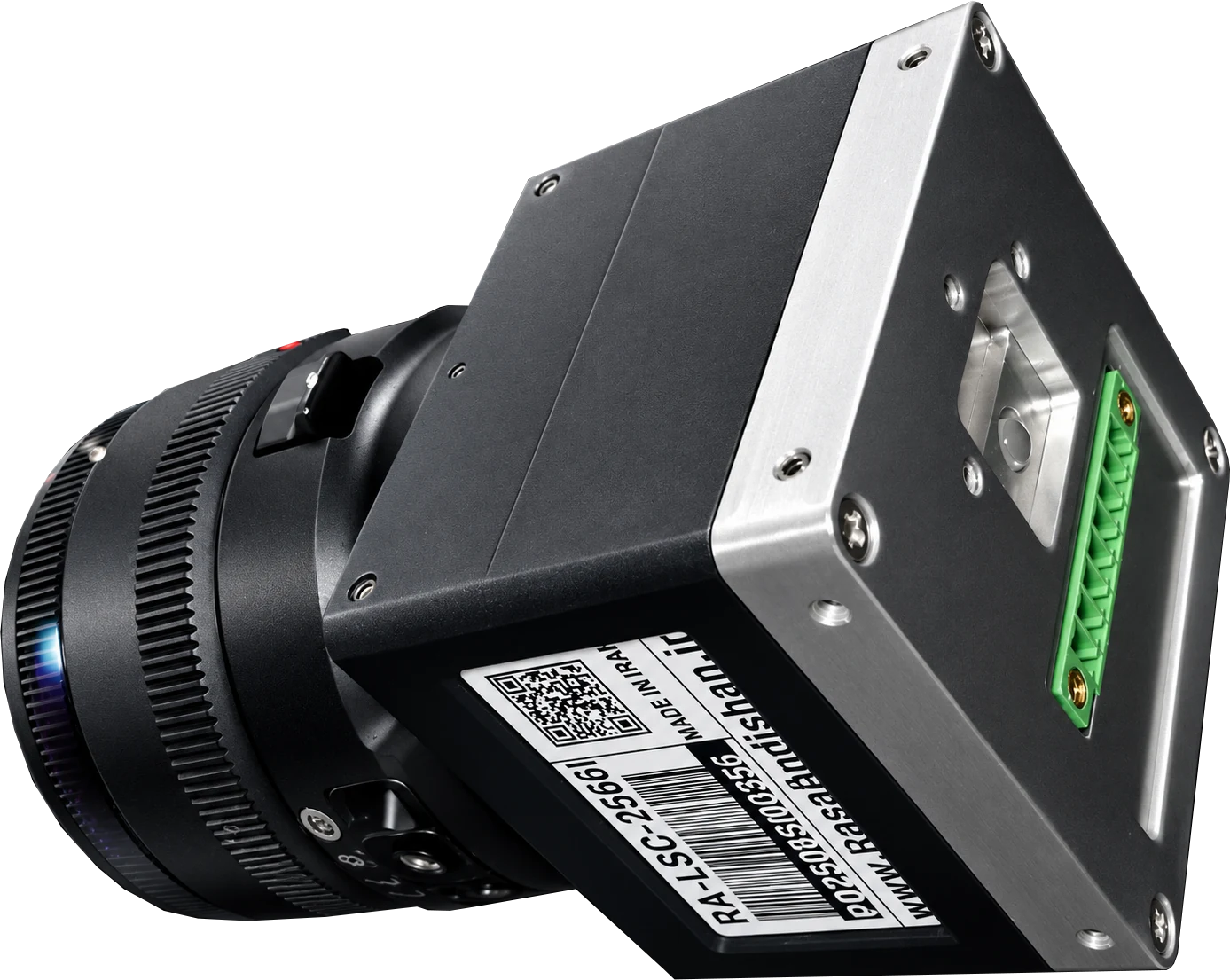
| RA-LSC-3753 USB Line Scan Camera Parameters | Specification |
|---|---|
| Sensor | Linear CCD Array |
| Pixel Size | 14 μm x 14 μm |
| Pixel Distance | 14 μm |
| Line Width | 14 μm |
| Effective Pixels | 1X2088 |
| Active Length | 29.232 mm |
| Spectral Range | 300 nm to 1100 nm |
| Max Pixel Frequency | 2 MHz |
| Dynamic Range | 375 |
| PGA Gain Resolution | 6 V/V - 64Steps |
| Programmable Offset Resolution | 300 mV - 512Steps± |
| Power consumption | 1.5 W |
| External Power | Not Required |
| Operational Temperature Range | −25 to +65 °C |
| Operation Systems | Windows 64-bit And Linux |
| Communication Port | USB2.0 Port |
| Multiple Cameras | Supported |
| Device Driver | Yes |
| Sample Codes | Matlab,LabView,C++,C#,VB.Net,Python |
| Camera Selection Guide | RA-LSC-3753-I |
|---|---|
| Processor | FPGA |
| Gain Adjust | ✓ |
| Offset Adjust | ✓ |
| ADC Resolution | 16 bit |
| USB Speed | 480Mbit/S |
| Analog OutPut | ✓ |
| On Board RAM | ✓ |
| Jitter Order | < 6.3 ns |
| Exposure Min | 1.064 ms |
| Exposure Max | 35.5 min |
| Exposure Resolution | 1 μs |
| Line Rate | 940 Hz |
| Operational Temperature Range | −25 to +65 °C |
| Availability | 3Days After Order |