
7500-pixel line scan camera, model RA-LSC-2717
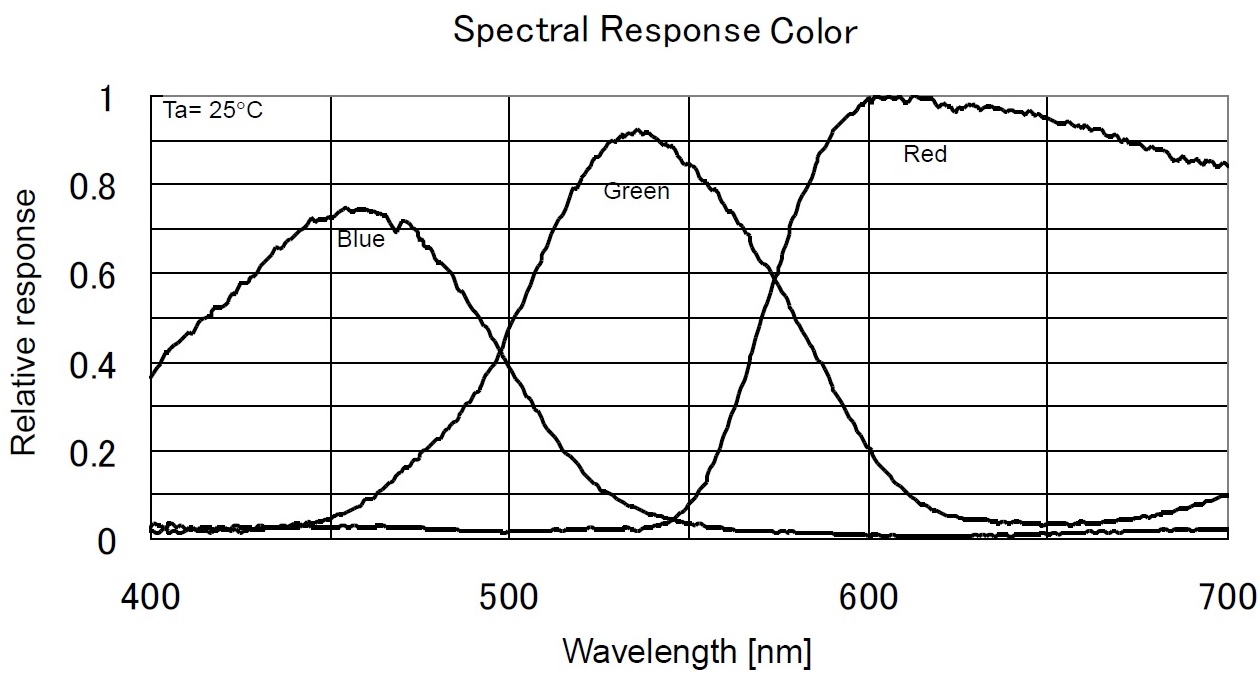
Design and construction of the RA-LSC-2717 line scan camera was completed in August 2024. The RA-LSC-2717 is a 7500-pixel color line scan camera that operates at 1068 Hz. You can use this camera to measure object width and to scan objects on a conveyor belt. The spectral response and parametric specifications of this camera are shown below.
Selection guide
Detailed color scanning and width measurement
If you need detailed color images of documents, objects or printed samples and your line is not especially fast, the RA-LSC-2717 is a good fit. Its sensor has three color lines of 7,500 pixels each, with 4.7 μm pixels over a 35.25 mm active length. The camera captures up to 1,068 lines/s and sends data to the PC over USB 3.0 at 3.2 Gbit/s. It runs from an external 7.5 to 8.5 V supply.
- Sensor
- Linear CCD Array
- Effective pixels
- 3 × 7500
- Pixel size
- 4.7 μm × 4.7 μm
- Active length
- 35.25 mm
- Line rate
- 1068 Hz
- Spectral range
- 400 nm to 700 nm
- Dynamic range
- 2000
- ADC resolution
- 3 × 8 bit
- Minimum exposure
- 936 μs
- Maximum exposure
- 14 min
With a 375 mm field of view, each pixel sees 50 μm of the object, and software processing finds the edge more precisely than one pixel. When object and background have similar brightness, color differences help tell them apart. Each line is a separate measurement, so you get 1,068 width readings per second.
To keep the image from being stretched or squashed, object speed has to match the line rate. If the camera sees a 375 mm width, each pixel covers 50 μm of the object and the object should move no faster than about 53 mm/s; with a 750 mm field this rises to about 107 mm/s. The 2000:1 dynamic range keeps surface texture visible in the image.
A 375 mm wide document or drawing is scanned at 50 μm, about 500 dots per inch, in three 8-bit channels. Exposure goes up to 14 minutes, so a stationary document can be scanned well even under weak light.
In a 375 mm field of view, misregistration and color shifts down to 50 μm are visible. Each line takes 936 μs, so at this 50 μm detail the line can run at most about 53 mm/s; if each pixel sees 100 μm, the limit rises to about 0.1 m/s. We recommend this camera for lines where detail matters more than speed.
Each color channel gives you 7,500 points across the fabric or sheet, so you can check color uniformity from edge to edge. Gain adjusts in 64 steps and offset in 512 steps, letting you balance all three channels against a white reference.
The pixels on this sensor are small, so each line needs at least 936 μs of exposure and the line rate tops out at 1,068 lines/s. In return, 7,500 pixels over 35.25 mm give you a lot of detail. To avoid a stretched or squashed image, the object should move exactly one pixel's worth per line. So if each pixel sees 50 μm of the object, the maximum speed is about 53 mm/s. At full line rate the camera produces about 192 Mbit/s, which USB 3.0 at 3.2 Gbit/s carries easily, and on-board RAM keeps the stream from breaking up. The 2000:1 dynamic range is wider than the 256 levels of the 8-bit ADC, so you use gain and offset to pick the brightness range that matters to you. The 400 to 700 nm range covers visible light, and the camera draws 1.7 W.
The lens focal length is roughly working distance × 35.25 mm ÷ field-of-view width. The pixels are 4.7 μm and the three color lines sit side by side, so choose a lens that resolves better than that and has very low chromatic aberration. At full speed the exposure is effectively fixed at 936 μs, so your white light must give enough signal in that short window. For static scans you can extend exposure up to 14 minutes. The -I version includes an FPGA, gain and offset adjustment, a 3 × 8-bit ADC, USB 3.0 at 3.2 Gbit/s, on-board RAM and jitter below 6.3 ns, and runs from a 7.5 to 8.5 V supply. If a higher line rate matters more than fine detail, also look at the RA-LSC-2566 at 4,536 lines/s.

| RA-LSC-2717 USB Line Scan Camera Parameters | Specification |
|---|---|
| Sensor | Linear CCD Array |
| Pixel Size | 4.7 μm x 4.7 μm |
| Pixel Distance | 4.7 μm |
| Line Width | 4.7 μm |
| Effective Pixels | 3X7500 |
| Active Length | 35.25 mm |
| Spectral Range | 400 nm to 700 nm |
| Max Pixel Frequency | 8.33 MHz |
| Dynamic Range | 2000 |
| PGA Gain Resolution | 6 V/V - 64Steps |
| Programmable Offset Resolution | 300 mV - 512Steps± |
| Power consumption | 1.7 W |
| External Power | 7.5-8.5 V |
| Operational Temperature Range | 0 to +60 °C |
| Operation Systems | Windows 64-bit And Linux |
| Communication Port | USB3.0 Port |
| Multiple Cameras | Supported |
| Device Driver | Yes |
| Sample Files | C++, C#,VB.Net,LabView,Matlab,Python |
| Camera Selection Guide | RA-LSC-2717-I |
|---|---|
| Processor | FPGA |
| Gain Adjust | ✓ |
| Offset Adjust | ✓ |
| ADC Resolution | 3x8 bit |
| USB Speed | 3.2Gbit/S |
| On Board RAM | ✓ |
| Jitter Order | < 6.3 ns |
| Exposure Min | 936 μs |
| Exposure Max | 14 min |
| Exposure Resolution | 1 μs |
| Line Rate | 1068 Hz |
| Operational Temperature Range | 0 to +60 °C |
| Availability | 3Days After Order |