
Article
Camera board
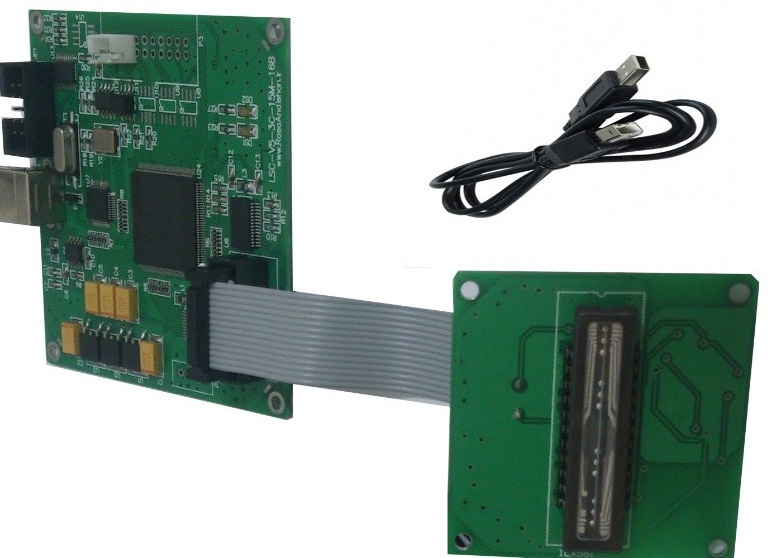
In response to widespread requests from some of our valued customers, RasaAndishan Mowj Pardaz also offers its linear CCD detectors in camera-board form. In this configuration, the CCD controller is connected to the CCD card by a flat cable. To view the company's range of CCD drivers, please click the Line Scan Camera menu.
The camera board is the RasaAndishan linear detector supplied as a board. In this form, the CCD controller connects to the CCD card with a flat cable. This design lets you fit the two parts separately inside your device.
A linear detector is an electronic interface circuit. It converts the analog pixels of a linear CCD sensor into digital data. Settings such as exposure time, signal gain and digital filters are applied to the data. The data is then sent to the computer. The interface software displays the sensor image the way you want.
With a line scan camera, a 2D image is formed only when the object and the camera move relative to each other. For example, imagine a train passing the camera at constant speed. In the resulting image, the width equals the camera's resolution. The length depends on the number of lines captured. If you capture 10,000 lines from a 2048-pixel camera, you get a 20-megapixel image.
RasaAndishan has brought up CCDs from brands such as Sony, Toshiba, Sharp, Hamamatsu and NEC in these systems. Free consultation and a three-year unconditional warranty are part of the company's after-sales service.
Line scan camera boards have a wide range of uses. Solar sensors, barcode readers, scanners and spectroscopy are examples. Systems that measure thickness, distance, speed and vibration also use them. RasaAndishan Mowj Pardaz is one of the first makers of linear detector cards in Iran. To learn more, see the Linear CCD detector page. The Charge-coupled device article on Wikipedia, which also explains how this sensor works.