
5-megapixel camera, model RA-ASC-5000
طراحی و ساخت دوربین 5 مگاپیکسلی RA-ASC-5000-I در اسفندماه 1400 به پایان رسید. این دوربین برخلاف دوربینهای مدل ASC-0229 و ASC-0267 مبتنی بر CCD نیست و از سنسور CMOS استفاده میکند. مودهای Double Shutter و Frame Straddling باعث میشوند این دوربین گزینه مناسبی برای کاربرد PIV باشد. این دوربین میتواند با منبع لیزر سینک شود و منبع لیزر را سینک کند. با مود AOI میتوانید ناحیهای خاص از تصویر را انتخاب کنید و در نتیجه سرعت تصویربرداری را بالا ببرید. رزولوشنهای متنوعی هم میتوانید تنظیم کنید. این ویژگیها و دهها قابلیت متنوع دیگر، این دوربین را گزینه مناسبی برای بسیاری از کاربردهای صنعتی و آزمایشگاهی میکند. پاسخ طیفی و مشخصات پارامتریک را در همین بخش میبینید.
Selection guide
For PIV, DIC and fast inspection over large fields
Five megapixels at 60 frames/s, with large 4.8 μm pixels. The RA-ASC-5000-I has a 2592 × 2048 CMOS sensor on a 12.440 mm × 9.8 mm imager, the largest CMOS sensor among our area-scan cameras. 8-bit data goes out over USB 3.0 at 2.54 Gbit/s, and the camera works from -30 to +70 °C. We built it for measuring velocity and displacement fields in fluid research and experimental mechanics, and for inspecting moving objects over wide fields.
- Sensor
- CMOS
- Effective pixels
- H2592 X V2048 =5M
- Pixel size
- 4.8 μm × 4.8 μm
- Active imager size
- 12.440 mm(H) * 9.8 mm(V)
- Frame rate
- Max 60 Hz
- Spectral range
- 400 nm to 700 nm
- ADC resolution
- 8 bit
- Interface
- USB3.0 Port
- Operating temperature
- −30 to +70 °C
The 23 μm² pixel collects about 4.8 times as much light scattered by small particles as a 2.2 μm pixel. In a 120 mm field each pixel sees 46 μm. So if a particle moves 8 pixels between two frames 16.7 ms apart, its speed is 22 mm/s.
In a wind tunnel or water channel, 2592 × 2048 pixels at a 1.27:1 aspect ratio cover a nearly square field with the same resolution in both directions. At 60 frames/s you can follow flow patterns as they change over tens of milliseconds.
In a 200 mm field each pixel sees 77 μm of the specimen, and 21-pixel subsets on a 10-pixel step give about 257 × 203 measurement points. With 16.7 ms between frames, loading stages longer than 0.1 s are captured in several frames each.
In a 400 mm field, each of the 2592 pixels across the image sees 154 μm. A part moving at 1 m/s travels 16.7 mm between frames. For a sharp image, the exposure must be short enough that the part moves less than one pixel during it.
At 60 frames/s and the full 5 megapixels, an event lasting a few hundred milliseconds is recorded over tens of frames. On-board RAM holds the sequence while it goes out over USB 3.0.
What sets this camera apart is large 4.8 μm pixels and 60 frames/s at the full 5 megapixels. Each pixel is 23 μm² and, at short exposures, collects about 4.8 times the signal of the 2.2 μm pixel in the RA-ASC-9031-I. That is why it works well even with low-energy pulsed light. In normal mode, consecutive frames are 16.7 ms apart. In PIV, frame straddling cuts this interval to a few microseconds, so in a 120 mm field you can measure speeds of several metres per second. At full rate, 2592 × 2048 pixels × 60 frames × 8 bits comes to about 2.55 Gbit/s, practically the full 2.54 Gbit/s link. That is also why the output is 8-bit. The large 12.440 mm sensor means that, for the same field of view, you need a focal length about 2.6 times that of the models with a 4.80 mm sensor.
Focal length is roughly working distance × sensor width ÷ field-of-view width. With a 12.440 mm sensor, a 300 mm field from 1 m needs a lens of about 41 mm. Because the sensor is large, the lens must cover an image circle over 15.8 mm and resolve detail near 4.8 μm. The lighting must give enough signal within a fraction of the 16.7 ms frame. In PIV, match the pulse energy to the area each pixel sees and to the flow speed. The -I version includes an FPGA, gain and offset adjustment, an 8-bit converter, 2.54 Gbit/s USB and on-board RAM, runs from -30 to +70 °C and ships 3 days after order. If the scene is static and you want finer detail, the RA-ASC-9031-I with 2.2 μm pixels and 12-bit output is the better choice.
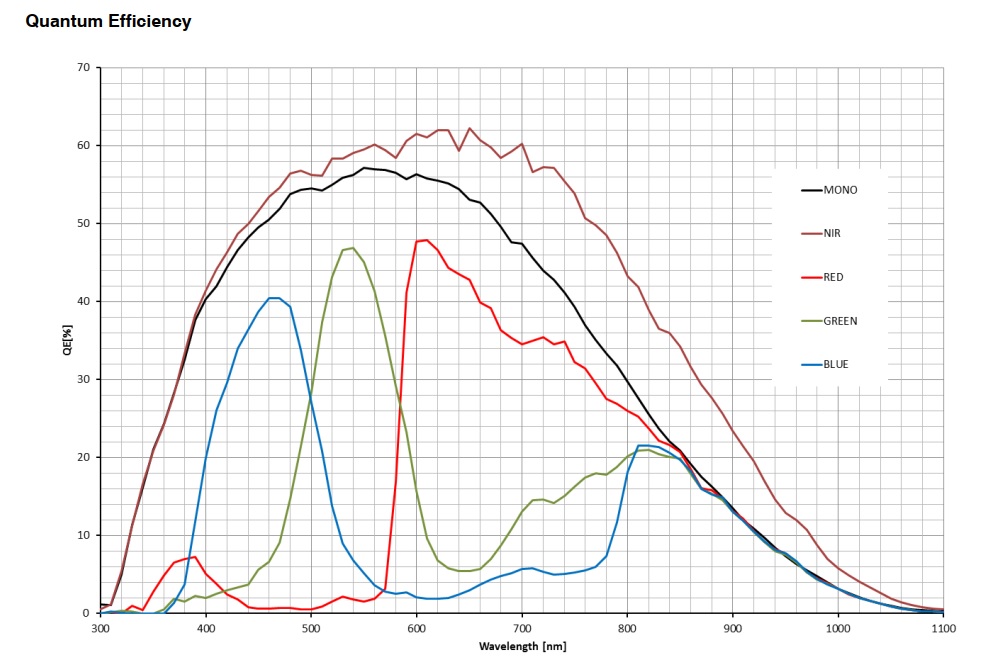
| RA-ASC-5000 USB Area Scan Camera Parameters | Specification |
|---|---|
| Sensor | CMOS |
| Pixel Size | 4.8 μm x 4.8 μm |
| Effective Pixels | H2592 X V2048 =5M |
| Active Imager Size | 12.440 mm(H) * 9.8 mm(V) |
| Spectral Range | 400 nm to 700 nm |
| Max Pixel Frequency | 350 MHz-OverClocking |
| Power consumption | 4.2 W |
| External Power | Not Required |
| Operational Temperature Range | −30 to +70 °C |
| Operation Systems | Windows 64-bit And Linux |
| Communication Port | USB3.0 Port |
| Multiple Cameras | Supported |
| Device Driver | Yes |
| Sample Codes | Matlab,LabView,C++,C#,VB.Net,Python |
| Camera Selection Guide | RA-ASC-5000-I |
|---|---|
| Processor | FPGA |
| Gain Adjust | ✓ |
| Offset Adjust | ✓ |
| ADC Resolution | 8 bit |
| USB Speed | 2.54Gbit/S |
| On Board RAM | ✓ |
| Jitter Order | < 10 ns |
| Frame Rate | Max 60 Hz |
| Operational Temperature Range | −30 to +70 °C |
| Availability | 3Days After Order |