
Article
Camera lenses
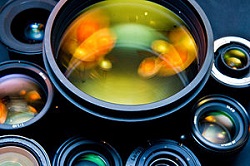
A camera lens is a cylinder that holds a set of optical elements. These elements pass light through and guide it into the camera so the image falls sharply on the film or image sensor. Image quality depends more on the lens than on the camera. Compact camera lenses cannot be changed. The lenses of some low-cost cameras cannot be removed either. But the lenses of single-lens reflex (SLR) cameras, some single-lens non-reflex cameras (the Contax series), and twin-lens non-reflex cameras (the Mamiya series) are interchangeable. Professional photographers usually own several lenses with different focal lengths and mount one on the camera depending on the subject. On a digital camera, each lens change lets some dust into the camera body, where it settles on the sensor. Over time this lowers image quality, so take care when changing lenses. Also, not every lens fits every camera. The lens control pins, which connect the lens to the camera's electronics, differ between cameras and models. The physical lens mount is not the same either.
The performance and quality of a lens depend on various factors, the most important of which are its focal length and f-number. Focal length is given in millimeters and indicates the lens's angle of view. The shorter the focal length, the wider the angle of view, or in photographers' terms, the wider the lens. The longer the focal length, the narrower the angle of view. Some lenses have a fixed focal length and others are variable; lenses with a variable focal length are more flexible and make framing easier for the photographer. Fixed focal length lenses, on the other hand, deliver higher quality.
In single-lens reflex film cameras (35 mm cameras), the film size is fixed, so the relationship between focal length and angle of view is also fixed. In digital cameras, however, the sensor size affects the lens's angle of view, and each type of camera has its own sensor size. So the angle of view of a lens can change depending on the camera and sensor size it is mounted on.
Choosing a camera lens is not only a concern for photographers. In industrial cameras, all the light that reaches the sensor also passes through the lens. If the lens is not suitable, even a high-resolution camera will not give a good image. So check the lens quality first. Then choose the focal length to match the angle of view and depth of field you need.
Each camera's field of view depends on the focal length and the sensor size. For a quick choice, use a focal length calculator. You can find more answers in the RasaAndishan FAQ. The Camera lens article on Wikipedia has more technical detail.