
1.4-megapixel camera, model RA-ASC-0267
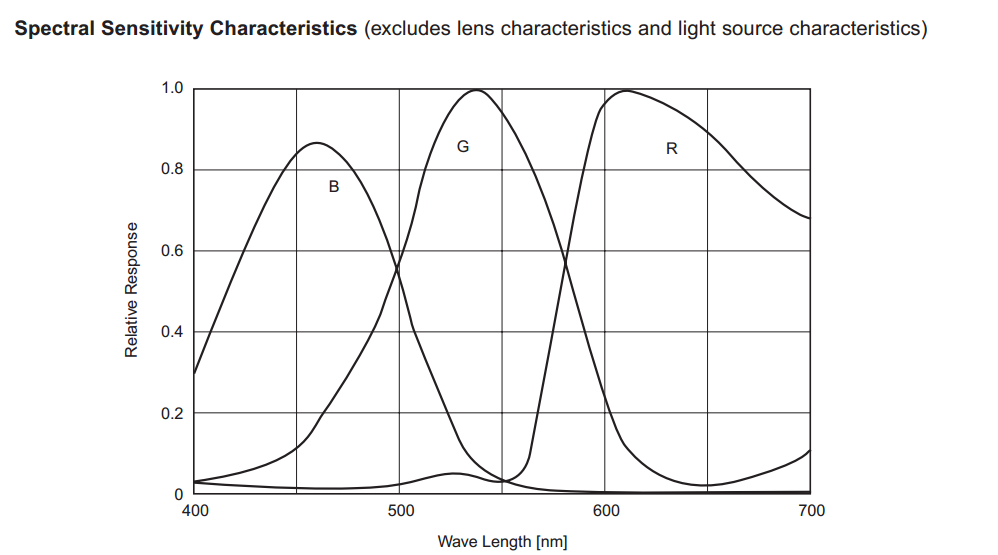
The design and manufacture of the RA-ASC-0267 area scan camera was completed in July 2017. This camera uses a CCD sensor. The CCD-based 1.4-megapixel (1360x1024) RA-ASC-0267 camera is an excellent choice for specialised high-sensitivity applications in laboratories. Its spectral response and parametric specifications can be viewed in this section.
Discontinued The sensor of this model is no longer made.
| RA-ASC-0267 USB Area Scan Camera Parameters | Specification |
|---|---|
| Sensor | Area CCD |
| Pixel Size | 4.65 μm x 4.65 μm |
| Effective Pixels | H1360 X V1024 = 1.4M |
| Total Pixels | H1434 X V1050 = 1.5M |
| CCD Size | 7.60 mm(H) * 6.20 mm(V) |
| Spectral Range | 400 nm to 700 nm |
| Max Pixel Frequency | 15 MHz |
| PGA Gain Resolution | 6 V/V - 64Steps |
| Programmable Offset Resolution | 300 mV - 512Steps± |
| Power consumption | 1.5 W |
| External Power | Not Required |
| Operational Temperature Range | −10 to +55 °C |
| Operation Systems | Windows 64-bit And Linux |
| Communication Port | USB2.0 Port |
| Multiple Cameras | Supported |
| Device Driver | Yes |
| Sample Codes | Matlab,LabView,C++,C#,VB.Net,Python |
Discontinued The sensor of this model is no longer made.
| Camera Selection Guide | RA-ASC-0267-I |
|---|---|
| Processor | FPGA |
| Gain Adjust | ✓ |
| Offset Adjust | ✓ |
| ADC Resolution | 8 bit |
| USB Speed | 480Mbit/S |
| On Board RAM | ✓ |
| Jitter Order | < 10 ns |
| Frame Rate | Max 8.1 Hz |
| Operational Temperature Range | −10 to +55 °C |
| Availability | 7Days After Order |
Selection guide
What this camera is good for
Detailed images of samples and stationary parts in visible light
When the object is still and detail matters, the RA-ASC-0267-I is a good choice. Its CCD has 1360 × 1024 pixels (1.4 megapixels) of 4.65 μm on a 7.60 mm × 6.20 mm area, the largest CCD among our area-scan cameras. It runs at up to 8.1 frames/s and sends 8-bit images over 480 Mbit/s USB. It is built for microscopy, specimen documentation and inspecting parts that stop at a station.
- Sensor
- Area CCD
- Effective pixels
- H1360 X V1024 = 1.4M
- Pixel size
- 4.65 μm × 4.65 μm
- Frame rate
- Max 8.1 Hz
- Spectral range
- 400 nm to 700 nm
- ADC resolution
- 8 bit
- Interface
- USB2.0 Port
- Operating temperature
- −10 to +55 °C
Microscopy and specimen documentation
Behind a 10× objective, the camera sees 0.76 mm × 0.62 mm of the specimen, and each 4.65 μm pixel corresponds to 0.465 μm on the sample. Pixels are the same size in both directions, so detail is recorded equally well horizontally and vertically.
Low-light lab imaging
At 8.1 frames/s each frame lasts 123 ms. In that time the 21.6 μm² pixel collects enough light even from dim scenes. With 64-step gain and 512-step offset, you fit the signal into the 256 levels of the 8-bit converter.
Measuring stationary parts
With a 76 mm field of view, each pixel sees 56 μm of the part across 1360 pixels. The scale is the same horizontally and vertically, so distances and diameters are measured with one scale in any direction.
Station-based part inspection
Where the part stops for inspection, the camera delivers each 1.4-megapixel image in under 125 ms. The data stream is about 90 Mbit/s, well within the 480 Mbit/s USB link.
What the specs mean in practice
A larger sensor means a longer focal length for the same field of view: about 1.75 times that of the RA-ASC-0229-I with its 4.34 mm sensor. The lens must also cover an image circle larger than the 9.8 mm sensor diagonal. The 4.65 μm pixel has up to 123 ms per frame to collect light, so it gives a good signal in low light. The 8.1 frames/s limit makes the use clear. The object has to be practically still during exposure, or the image blurs. So this camera belongs at an inspection station or on a microscope, not on parts moving past it. The 8-bit output has 256 levels, set to the scene brightness with gain and offset. The 400 to 700 nm response works well with ordinary white light sources.
Before you order
Focal length is roughly working distance × sensor width ÷ field-of-view width. With a 7.60 mm sensor, a 76 mm field at 400 mm calls for a 40 mm lens. On a microscope, pick an adapter whose image circle is larger than 9.8 mm. The lighting must give enough signal within the 123 ms frame and, for measurement, be uniform and flicker-free. The -I version includes an FPGA, gain and offset adjustment, an 8-bit converter, 480 Mbit/s USB and on-board RAM. It runs from -10 to +55 °C and ships 7 days after order. If you need more frames per second, look at the RA-ASC-0134-I, a CMOS camera running at 72 frames/s.