
Article
Particle image velocimetry (PIV)
RasaAndishan Mowj Pardaz is one of the first makers of particle image velocimetry (PIV) cameras in Iran.
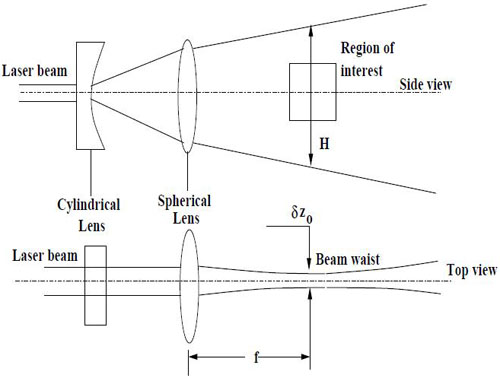
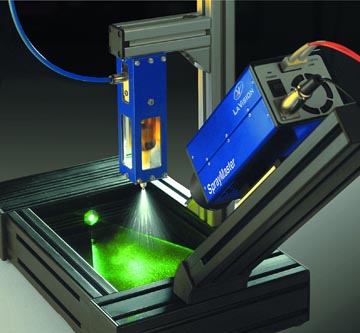
Particle image velocimetry (PIV) is a method for measuring the velocity field of a fluid. The mechanism of particle image velocimetry is very simple, but the equipment it uses is often very expensive. In PIV, a laser beam is first fired. Special lenses shape this light into a sheet (Figure 1), and this light sheet illuminates a region inside the fluid. The fluid contains particles that have been injected into it at a suitable concentration to mark positions. By capturing two consecutive images with a digital camera and sending them to a computer, the images are stored. A numerical algorithm then compares the two images to determine the displacement of the particles. In the simplest set-up, which uses a single camera, two velocity components of the flow can be measured in the illuminated plane. Figure 2 shows an example of this experiment for measuring spray velocity.
This method has advantages and disadvantages. Its first advantage is non-intrusive velocity measurement, while methods such as hot-wire and Pitot tube disturb the fluid flow. If you choose particles whose properties are as close as possible to those of the test fluid, this method interferes very little with the flow. Its second advantage is that it measures the whole flow field at a single instant. With hot-wire or Pitot tube methods, you have to move the entire measuring device through the flow. If the flow is unsteady, this becomes a problem. Also, if the camera you use is fast, you can observe high-speed phenomena in the fluid. This method gives a 2D velocity field, and with other methods you can also obtain 3D velocity fields.
Besides these advantages, particle image velocimetry also has disadvantages. One is that particles are added to the fluid. These particles never follow the fluid's flow pattern perfectly. The added particles may also change the properties of the test fluid. If you use only one camera, you cannot capture the flow pattern of phenomena with 3D flow. In that case, the 3D flow causes errors in the test results. This method measures the average velocity of the flow. Another drawback is that the added particles may leave the laser sheet and cause errors in the test results.
In PIV, the camera takes two consecutive images of illuminated particles. Precise synchronization between the camera and the laser pulse is essential in this method. All RasaAndishan cameras support external triggering. This way, you can synchronize imaging with the light source.
Unlike line scan cameras, area scan cameras build a complete image of the field of view in every frame. That is why they are suited to comparing two consecutive images. RasaAndishan area scan cameras cover both USB2 and USB3 interfaces. See the different models on the Image processing camera page. For further reading, see the Particle image velocimetry article on Wikipedia.